Yangzijiang Maritime Sells Bulk Vessels 2027-2028 | Mariner News
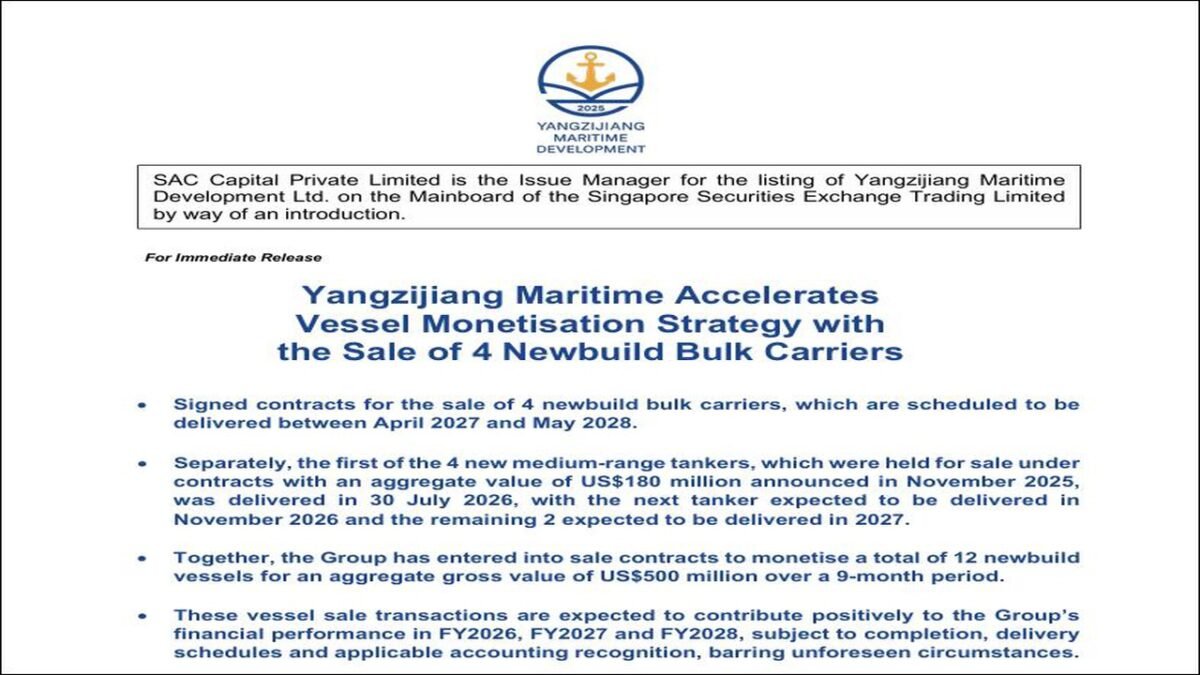
Yangzijiang Maritime, the prominent Singapore-based investment company, has recently made headlines with a significant strategic move: the sale of a string of vessels, specifically a series of advanced bulk carriers. This divestment, involving ships slated for delivery in 2027 and 2028, underscores a dynamic approach to fleet management and a keen eye on the evolving global shipping market. The transaction, though specific financial details are often confidential, signals a calculated adjustment within Yangzijiang Maritime’s extensive maritime portfolio, sparking considerable discussion among industry analysts and stakeholders about the underlying market conditions and future trajectory of the dry bulk sector.
This decision to offload newbuild bulk carriers, long before they even touch water, is particularly noteworthy. It suggests a proactive strategy to capitalize on current market valuations or to rebalance asset exposure. For a major player like Yangzijiang Maritime, which is not primarily an operator but an investor in maritime assets, such moves are typically driven by comprehensive market intelligence and long-term financial objectives. The timing of these sales, focusing on future deliveries, could indicate anticipated shifts in supply-demand dynamics, raw material trade flows, or even regulatory landscapes that might influence vessel profitability in the latter part of the decade. This development offers a fascinating glimpse into the strategic thinking that underpins large-scale maritime investment.
Strategic Fleet Divestment Amidst Market Volatility
Yangzijiang Maritime’s move to sell a series of bulk carriers represents a sophisticated exercise in strategic fleet divestment. Given the long lead times associated with shipbuilding, securing delivery slots years in advance is standard practice. However, the decision to sell these newbuilds—scheduled for 2027 and 2028—suggests a re-evaluation of the company’s long-term asset strategy. Such actions are rarely spontaneous; they typically stem from an intricate analysis of projected freight rates, shipbuilding costs, fuel price trends, and the overall macroeconomic environment.
For an investment firm heavily involved in the maritime sector, optimizing its asset base is paramount. Selling vessels before delivery can minimize exposure to potential downturns, free up capital for other lucrative opportunities, or adjust the fleet profile to align with anticipated market needs. This proactive stance contrasts with reactive measures often seen during market slumps, positioning Yangzijiang Maritime as a nimble player capable of anticipating and responding to shifts in the highly cyclical dry bulk shipping market.
This strategic repositioning could also be influenced by the ongoing uncertainties in global trade, geopolitical tensions, and the accelerating decarbonization agenda within shipping. New environmental regulations, such as those from the International Maritime Organization (IMO), will increasingly impact vessel designs, operational costs, and ultimately, asset values. Divesting certain assets now might allow Yangzijiang Maritime to invest in greener technologies or more future-proof vessel types, ensuring the long-term sustainability and competitiveness of its remaining or future fleet.
Understanding Yangzijiang Maritime’s Portfolio Management Approach
As a prominent Singapore-based maritime investment company, Yangzijiang Maritime employs a sophisticated approach to portfolio management, distinguishing itself from traditional shipowners focused solely on operations. Their strategy involves both aggressive expansion and judicious divestment, reflecting a flexible and opportunistic outlook on global shipping assets. The sale of these bulk carriers is not an isolated incident but rather a testament to their continuous optimization efforts, balancing risk and return across various segments of the shipping industry.
Their recent history, as indicated by related news, includes both substantial new orders, such as Yangzijiang Maritime Development doubling its fleet, and strategic sales. This dual approach highlights a sophisticated understanding of market cycles and asset valuation. By both acquiring and divesting, they aim to maximize the value of their maritime investments, rather than simply expanding or maintaining a static fleet. This active management style is crucial in the volatile shipping market, where asset values and earnings can fluctuate dramatically.
The focus on bulk carriers for this sale is particularly telling. The dry bulk segment is highly susceptible to global economic health, commodity demand, and agricultural outputs. Managing a portfolio of bulk vessels requires foresight into these complex interconnected factors. Yangzijiang Maritime’s decision likely involves a meticulous assessment of future supply-demand balances for commodities, the trajectory of global GDP growth, and the competitiveness of the existing and future bulk fleet, ensuring their investment decisions are resilient and adaptable.
Impact on the Global Dry Bulk Shipping Sector
The divestment of a string of bulk carriers by a significant player like Yangzijiang Maritime invariably sends ripples through the global dry bulk shipping sector. While the exact number of vessels sold and their specific types (e.g., Capesize, Panamax, Supramax) remain undisclosed in the broader public description, the sheer mention of a ‘series’ suggests a material impact. Such a sale could influence several key aspects of the market, including vessel supply, freight rate expectations, and even sentiment among other investors and shipowners.
Firstly, it alters the forward supply outlook. If these vessels are acquired by other entities that intend to operate them as planned, the overall supply of bulk carrier tonnage for 2027 and 2028 remains unchanged. However, if the buyer has different deployment strategies, or if Yangzijiang Maritime’s exit signals a broader trend, it could affect market balance. More importantly, the psychological impact of a major investor selling newbuilds can lead others to question their own long-term strategies, potentially prompting further transactions or re-evaluations across the industry.
Furthermore, such high-profile transactions can serve as bellwethers for market sentiment. When a savvy investment company like Yangzijiang Maritime makes a significant move, it is often interpreted as a signal about the perceived future health of that specific segment. This could either reinforce positive outlooks if the sale is seen as opportunistic profit-taking, or it could raise concerns if interpreted as a defensive move against anticipated oversupply or weakening demand. The ripple effect extends to financing institutions, charterers, and other stakeholders, all of whom closely watch these strategic maneuvers to inform their own decisions within the intricate global shipping ecosystem.
Future Projections and Industry Trends in Bulk Shipping
Yangzijiang Maritime’s recent divestment of bulk carriers provides a potent lens through which to examine future projections and prevailing industry trends within the bulk shipping sector. The years 2027 and 2028 are critical junctures for the maritime industry, marked by anticipated stringent environmental regulations and continued technological advancements. This strategic sale could be a preemptive move to navigate these forthcoming changes, signaling a shift towards a more optimized and possibly greener fleet profile for the company.
The global dry bulk market is constantly influenced by macro-economic factors such as industrial production, infrastructure development, and agricultural harvests, especially from major commodity exporters and importers. As global supply chains evolve and nations pursue decarbonization goals, the demand patterns for iron ore, coal, grain, and other dry bulk commodities are subject to significant shifts. Yangzijiang Maritime’s decision may reflect an strategic assessment of these long-term demand trends, perhaps predicting a flattening or even decline in certain bulk trades in the latter half of the decade, making early exit from some commitments a sensible financial choice.
Moreover, the sale highlights the persistent challenge of managing newbuild orders in a rapidly changing environment. Shipyards globally are increasingly busy with orders for alternative fuel vessels and those designed to meet EEXI/CII regulations, which might push up newbuild prices and delivery times. By selling older-spec newbuilds, Yangzijiang Maritime could be clearing its books to invest in next-generation vessels that promise better fuel efficiency and lower emissions, aligning with both profitability goals and sustainability objectives. This forward-thinking approach underscores the complex interplay between financial strategy, environmental compliance, and market foresight in today’s maritime industry.
Conclusion: A Strategic Pivot in Maritime Investment
Yangzijiang Maritime’s decision to sell a string of bulk carriers set for delivery in 2027 and 2028 is more than just a transaction; it represents a significant strategic pivot within its maritime investment portfolio. This move by the Singapore-based company is indicative of sophisticated market analysis and a proactive stance in navigating the volatile dry bulk shipping sector. It suggests a calculated effort to optimize assets, manage future market risks, and potentially realign investment priorities with emerging industry trends, including the imperative for environmental sustainability and evolving global trade dynamics.
By divesting these newbuilds, Yangzijiang Maritime demonstrates an agile approach to capital allocation, potentially freeing up resources for opportunities in other shipping segments or for investments in technologically advanced and environmentally compliant vessels. This proactive management ensures that the company remains resilient and competitive in an ever-changing maritime landscape. The sale serves as a valuable case study for the broader shipping community, illustrating how major players adapt their fleets and investment strategies in response to projected market shifts and regulatory pressures. It reinforces the notion that success in modern shipping often hinges on foresight, adaptability, and a willingness to make bold, strategic decisions long before market changes become universally apparent.