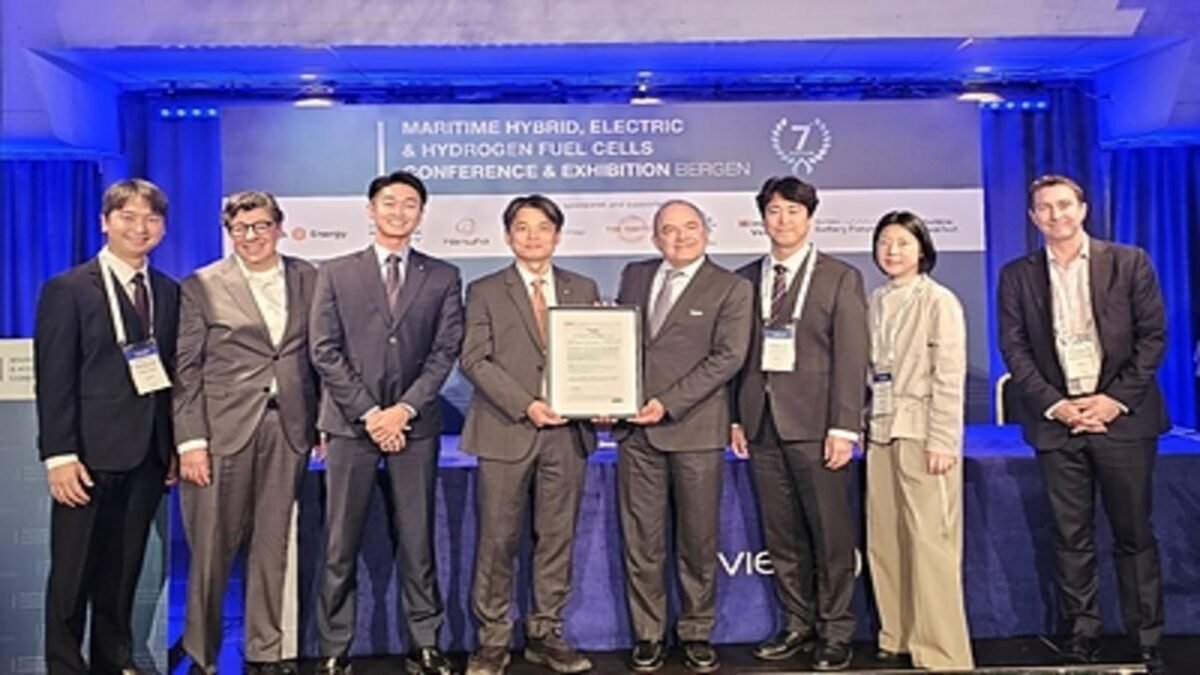
Hanwha Power Wins ABS Approval for Battery-Powered Boxship
Hanwha Power has received Approval in Principle (AiP) from ABS for a 1,700 TEU battery-powered container ship design, marking a move toward zero-emission regional logistics. The vessel design relies on a 151 MWh battery system for full-electric propulsion, with recharging operations centralized at port facilities.
Strategic Design Implications
The adoption of containerised battery units represents a departure from fixed battery room configurations. By utilizing standard container slots for energy storage, operators gain the flexibility to replace modules as battery degradation occurs or as technology evolves. This modular approach mitigates the risk of vessel obsolescence and simplifies maintenance, effectively decoupling the vessel’s primary power source from the hull’s expected lifecycle.
Operational Constraints
While this design targets the short-sea and regional market, the reliance on massive shore-side charging infrastructure suggests that vessel deployment will be tethered to specific trade lanes with high-capacity grid connectivity. Unlike conventional bunker operations, which are increasingly port-agnostic, the operational viability of this design will be contingent on the energy infrastructure at the berths rather than just the ship’s technical capabilities.
Portfolio Expansion
Hanwha Power’s announcement coincides with the completion of a basic design for a smaller 1,000 TEU electric vessel. The AiP was formally presented to the firm at the 2026 Maritime Hybrid, Electric & Hydrogen Fuel Cells Conference in Bergen, Norway.