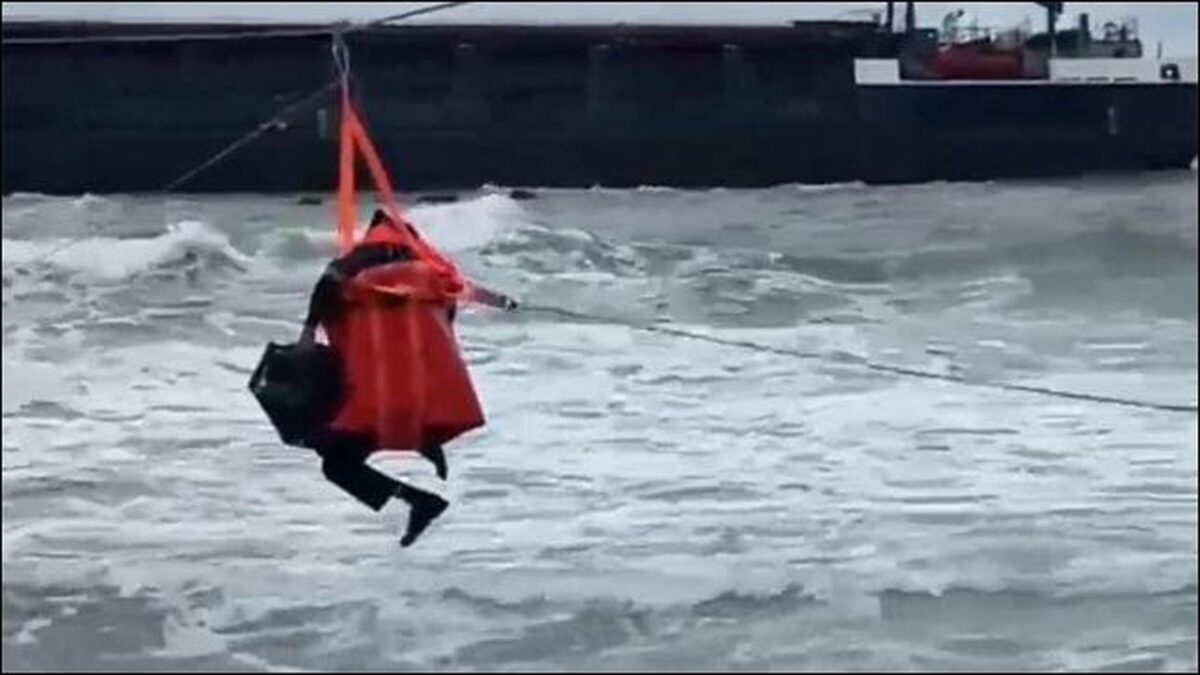
Breeches Buoy Rescues Crew from Grounded Cargo Ship in Turkey | Mariner News
In a remarkable display of courage and precision, Turkish maritime rescue teams recently executed a harrowing breeches buoy rescue, saving eight crewmembers from a cargo ship grounded in a ferocious Black Sea storm. This dramatic incident, unfolding off Turkey’s northern coast near Sakarya, highlights both nature’s destructive power and the enduring efficacy of traditional rescue techniques. The grounded cargo ship, identified as the Ninova, presented a formidable challenge, but a coordinated response ensured all crew reached safety, an outcome celebrated across mariner news outlets.
Black Sea Storm Causes Ship Grounding
The early hours of May 1 witnessed the Black Sea unleash its fury, battering the Turkish coastline with heavy surf, strong winds, and relentless, intermittent heavy rains. These severe weather conditions created a treacherous environment for any vessel, especially one with potential operational issues. Against this backdrop, the 2,500 dwt cargo ship Ninova, a vessel with a reported history of problems, found itself in grave danger. It began dragging its anchor, losing purchase against the seabed, and despite the crew’s best efforts, the tempest ultimately drove it ashore near Sakarya.
By 09:00, the Ninova was firmly aground, its eight-person crew in peril. The Directorate General of Coastal Safety (KEGM), Turkish Coast Guard, local police, and fire departments swiftly mobilized in response to the reports of the shipping being driven ashore. However, extreme weather presented significant obstacles. Towering waves and powerful currents made water-based approaches impossible for smaller rescue craft, deeming direct extraction too hazardous for both rescuers and the stranded sailors.
Compounding these difficulties, high winds and turbulent air conditions rendered helicopter hoist operations equally unfeasible; helicopters require stable conditions for such delicate maneuvers, which the tempestuous gusts prevented. With both sea and air avenues blocked, Turkish rescue teams faced a critical dilemma: how to safely extract the crew. The 83-meter (272-foot) ship, built in 1989, was continuously pounded by surf, raising concerns about its structural integrity. Decision-makers recognized the urgency and the need for a different, proven methodology to avert a potential catastrophe, turning to a time-tested marine emergency operation.
The Ingenious Breeches Buoy Rescue Operation
In a testament to the enduring value of tried-and-true methods, the decision was made to deploy a breeches buoy system. This classic marine emergency operation technique has saved countless lives over centuries, proving ideal for ship-to-shore transfers when other means are too dangerous or impossible. Its inherent reliability in extreme conditions, where modern technology might fail, makes it an invaluable tool for coastal rescue operations.
Deployment began with the critical step of establishing a connection between the shore and the grounded ship. Rescue teams expertly fired a lightweight guideline onto the Ninova. With incredible precision, the line soared through the gale-force winds and landed successfully on the deck. The stranded crew, recognizing their lifeline, quickly secured the guideline, understanding that their survival depended on the meticulous execution of subsequent steps. This initial connection was followed by the arduous task of pulling heavier lines, including the main hawser, from the shore to the ship, which the crew then securely fastened, creating the robust rope system for their transfer.
One by one, under the watchful eyes of the combined rescue forces, the eight crewmembers were painstakingly transferred from the ship to the shore. Each sailor was carefully placed into the breeches buoy, secured, and then winched across the churning waters to the waiting embrace of the rescue personnel. This methodical process, demanding immense concentration and coordination from both those on the ship and those on shore, showcased the unparalleled professionalism of the Turkish maritime rescue teams. The successful operation of the breeches buoy system underscores its critical role in complex shipwreck rescues, proving that effective solutions often stand the test of time. Every individual reached safety without incident, a true testament to emergency preparedness.
The Troubled History of the Grounded Cargo Ship Ninova
The vessel at the heart of this dramatic maritime incident, the Ninova, carries a history adding complexity to its predicament. Built in 1989, making it 37 years old, the ship has undoubtedly seen many years of service across various seas. While older vessels can still operate safely with proper maintenance, their age often correlates with increased operational risks and higher susceptibility to mechanical failures, particularly when facing severe weather conditions, factors potentially at play in this recent stranding.
This ambiguity regarding ownership and management is a significant concern within the maritime industry. Unclear ownership structures can complicate issues of responsibility, maintenance standards, and adherence to international safety regulations. Such vessels, sometimes referred to as “flag-of-convenience” ships when registered in countries with less stringent oversight, can pose higher risks to their crews and the marine environment. The Ninova, for instance, is currently registered in Cameroon, a detail that raises questions about the regularity and rigor of its inspections and operational compliance, especially given the nature of its grounding during a storm.
Lack of transparent ownership further hinders efforts to ensure vessels meet essential safety benchmarks, potentially endangering crew members and contributing to marine emergencies. The vessel’s relatively small size for a cargo ship, at 2,500 dwt and 83 meters in length, suggests it might be involved in coastal trade or shorter voyages, an operation that still demands robust safety protocols and well-maintained machinery. The fact that the Ninova dragged anchor during a storm indicates either an inadequate anchoring system for the conditions, human error, or a combination, exacerbated by its age and questionable operational oversight. Such incidents underscore the urgent need for stringent global enforcement of maritime safety standards and greater transparency in ship ownership to prevent similar occurrences and protect the lives of seafarers worldwide. The long-term implications for the grounded Ninova remain uncertain, with salvage operations likely to be complex given its location and the conditions that led to its grounding.
Crew Safety and Post-Rescue Care in Maritime Emergencies
At the heart of every maritime rescue operation is the human element: the lives of the crew members who face the immediate danger. The eight individuals aboard the Ninova endured a terrifying ordeal, isolated on a rapidly deteriorating vessel amidst a raging storm. Their emotional and physical resilience during the initial hours of the grounding and the subsequent, painstaking breeches buoy transfer is commendable. Being subjected to the constant buffeting of waves, the howl of the wind, and the uncertainty of their fate takes an immense toll, both physically and psychologically. The relief felt upon reaching the solid ground of the shore must have been overwhelming.
Upon their arrival, the crew was immediately attended to by medical personnel. Standard procedure after such traumatic shipwreck rescues includes thorough medical checks to assess for any injuries, hypothermia, shock, or other stress-related conditions. While the report indicated they were brought ashore “without incident,” meaning no apparent physical injuries during the transfer, the underlying stress and exposure can have lasting effects. Access to psychological support and counseling is often a crucial, though sometimes overlooked, aspect of post-rescue care, helping seafarers process their traumatic experiences and recover fully.
The swift and successful extraction of all eight crewmembers stands as a powerful testament to the unwavering dedication of the Turkish Coast Guard, KEGM, and all supporting agencies. Their primary mission to preserve human life at sea was upheld with utmost professionalism. This incident reinforces the critical importance of regular training, not just for the rescuers, but also for ship crews themselves, in emergency procedures and cooperation during distress situations. Understanding how to respond to a grounding, how to assist rescue teams, and how to utilize safety equipment effectively can make the difference between life and death. The seamless coordination between diverse emergency services in Sakarya exemplifies effective maritime emergency preparedness, a model for other coastal nations facing similar challenges.
Lessons for Future Maritime Safety and Prevention
The dramatic cargo ship rescue in the Black Sea offers invaluable lessons for the broader maritime industry regarding preparedness, response, and vessel management. Firstly, it underscores the persistent and unpredictable threat posed by extreme weather events. Climate change is predicted to increase the frequency and intensity of storms, making robust weather forecasting, accurate storm warnings, and proactive decision-making by ship masters more critical than ever. Owners and operators must ensure their vessels are adequately prepared for severe conditions, with well-maintained anchoring systems, reliable propulsion, and comprehensive emergency plans.
Secondly, the incident reaffirms the vital role of integrated maritime safety protocols and inter-agency cooperation. The successful outcome near Sakarya was a direct result of the combined efforts of the Directorate General of Coastal Safety, the Coast Guard, local police, and fire departments. This synergy is crucial for effective coastal rescue operations, demonstrating that a unified command structure and well-drilled collaborative procedures are paramount in emergencies. Regular joint exercises and clear communication channels are essential to hone these responses and ensure efficient execution when lives are on the line.
Finally, the case of the Ninova highlights ongoing concerns about vessel age, maintenance standards, and transparency in ship ownership. While the breeches buoy proved to be an indispensable tool in this specific marine operation, preventing such groundings in the first place must remain the ultimate goal. Enhanced regulatory oversight, stricter enforcement of international conventions on maritime safety, and greater accountability for ship owners are necessary steps. As technology advances, so too must our commitment to safeguarding seafarers and the marine environment. The traditional breeches buoy rescue may seem like a relic from another era, but its effective deployment here serves as a powerful reminder that sometimes, the simplest, most reliable solutions are the ones that continue to save lives in the face of modern maritime perils, ensuring that tales of heroism endure in the annals of mariner news. The commitment to continuous improvement in emergency preparedness and ship grounding prevention remains a top priority for global maritime authorities.