Global Bunker Demand Surges 2% in 2025 Survey | Mariner News
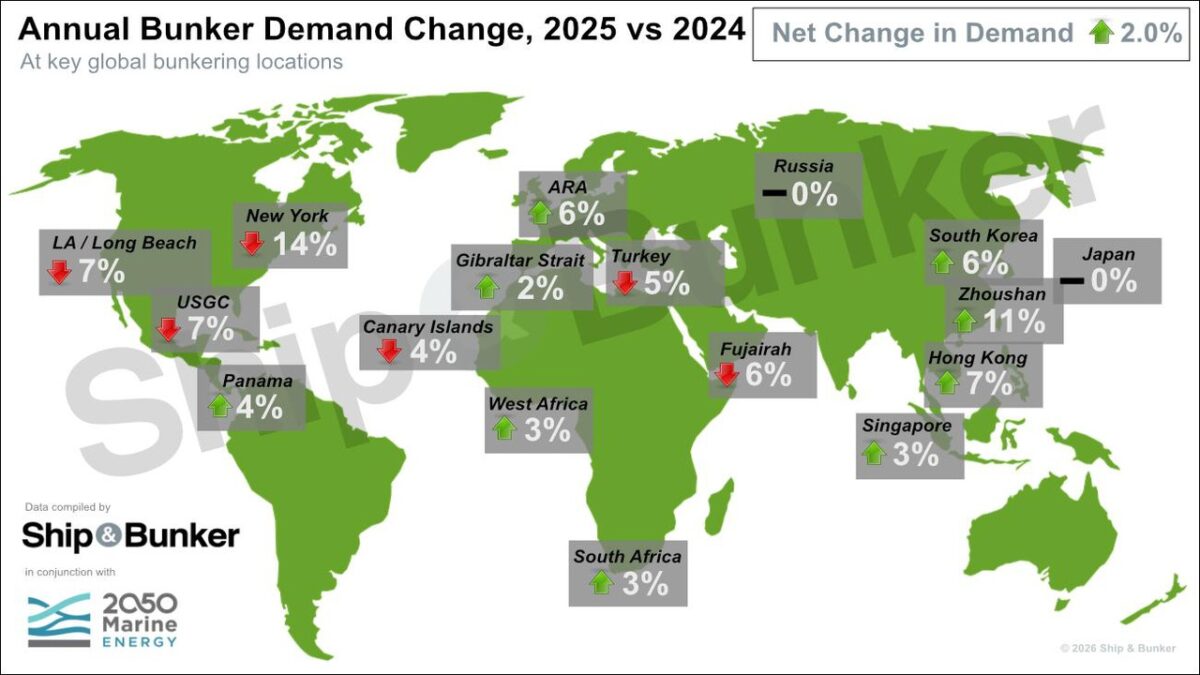
The global maritime industry witnessed a significant rebound in marine fuel consumption, with overall global bunker demand experiencing a robust 2% increase in 2025 compared to the previous year. This impressive annual growth was substantially propelled by a powerful performance in the fourth quarter of 2025, which saw a 2.9% average advance over Q4 2024. These compelling figures, revealing the highest global sales level since 2019, underscore a revitalized shipping sector and renewed confidence across key maritime trade routes, according to the latest comprehensive market survey conducted by Ship & Bunker and consultancy 2050 Marine Energy.
The detailed survey, which meticulously analyzed bunker sales volumes across 17 leading global locations, provides an invaluable snapshot of the health and trajectory of the marine fuel market. The combined data from market participants and official sources, covering approximately 59.7% of total global sales, indicates a resilient recovery in shipping activities. This surge in 2025 global bunker demand signals a positive shift, offering crucial insights for fuel suppliers, vessel operators, and policymakers navigating the complexities of international trade and maritime logistics.
Unpacking the 2025 Global Bunker Demand Surge
The headline figure of a 2% annual increase in global bunker demand for 2025 masks a quarter-by-quarter narrative of accelerating growth. The fourth quarter of 2025 emerged as a pivotal period, registering a substantial 2.9% year-on-year gain in marine fuel volumes. This impressive Q4 performance significantly contributed to the overall yearly uptick, demonstrating a strong finish to the year and setting an optimistic tone for the shipping industry.
Comparing this to earlier periods, the Q4 2025 advance slightly outpaced the 4.3% year-on-year gain observed in Q3. Sequentially, Q4 volumes also showed a healthy expansion, rising 1.3% higher than those recorded in Q3. These statistics illustrate a consistent upward trend in marine fuel consumption, reflecting sustained increases in global trade activity and vessel traffic. The data emphatically points towards a vigorous recovery in shipping demand, with vessels requiring more fuel as they navigate more frequently and across longer distances.
This robust growth propelled the total global bunker sales for 2025 to their highest point since 2019, effectively erasing the downturns experienced in the intervening years. The implications of this return to pre-pandemic levels are profound, suggesting a return to stability and growth for the shipping sector. Market participants, ranging from major oil companies to independent bunker traders, will likely interpret these figures as a strong indicator of enduring demand for conventional marine fuels, even as discussions around decarbonization intensify.
Regional Dynamics: Tariffs and Market Shifts
While the overall picture for 2025 global bunker demand is positive, the survey highlighted significant regional disparities, particularly within the Americas. The report specifically noted that US tariff policy continued to exert a negative influence on volumes in both the United States and Panama, leading to a noticeable decline in marine fuel sales in these key bunkering regions. This impact underscores the sensitivity of the bunker market to geopolitical and trade policy shifts, which can redirect shipping routes and alter fuel purchasing patterns.
Adrian Tolson, a prominent voice in the industry, was quoted in the original survey, stating, “Real decline can be seen in the Americas, where the impact of tariffs has taken a toll on demand.” This observation emphasizes how trade barriers can effectively reroute maritime traffic away from traditional hubs, prompting vessels to refuel in alternative locations unaffected by such policies. Consequently, regions like Asia/Pacific and parts of EMEA may have seen increased activity as shipping lines adjusted their strategies to mitigate tariff-related costs and operational hurdles.
Such regional shifts underscore the dynamic nature of the global bunker market. While some areas experienced challenges, others capitalized on the redirected traffic, leading to a rebalancing of marine fuel sales across different continents. Understanding these localized trends is critical for stakeholders looking to optimize their supply chains and investment strategies, as the resilience and growth of global bunker demand are not uniformly distributed but are rather a mosaic of varying regional performances influenced by a myriad of factors.
Key Factors Driving Marine Fuel Consumption
The resurgence in 2025 global bunker demand can be attributed to several interconnected factors that have collectively contributed to heightened shipping activity. A primary driver has been the broader global economic recovery, which has stimulated international trade and increased the movement of goods across oceans. As economies reopened and consumer demand strengthened, the need for raw materials and finished products to be transported via sea escalated, directly translating into greater fuel consumption.
Furthermore, the shipping industry itself has seen an increase in operational tempo. Factors such as improved freight rates, higher port call frequencies, and an expanding global fleet, albeit with some capacity constraints, have all contributed to the demand for marine fuel. The efficiency gains in vessel operations and supply chain management, while aimed at reducing fuel consumption per voyage, have been largely offset by the sheer increase in the volume and frequency of global trade flows.
Geopolitical influences also played a role, albeit with mixed effects. While some trade policies, like the US tariffs, negatively impacted specific regions, other geopolitical alignments or disruptions might have indirectly boosted shipping activity in alternative routes. Moreover, the stability of oil prices through parts of 2025 could have offered some predictability for carriers, encouraging more frequent voyages without the specter of volatile fuel costs significantly eroding profits. The interplay of these complex factors highlights the intricate ecosystem that shapes the demand for marine fuels.
The Future Outlook for Bunker Markets
The strong finish to 2025 for global bunker demand provides a valuable springboard for projections into 2026 and beyond, yet the future remains characterized by a blend of opportunities and evolving challenges. The upward trend observed in the market survey suggests a fundamental strength in the shipping industry’s recovery, indicating that conventional marine fuel will continue to be the backbone of global trade for the foreseeable future. However, several critical factors will influence the trajectory of bunker markets in the coming years.
Continued global economic forecasts will play a significant role. Sustained economic growth will likely translate into higher trade volumes and, consequently, greater marine fuel consumption. Conversely, any economic slowdowns or geopolitical instabilities that disrupt trade routes or supply chains could temper demand. The ongoing evolution of international trade agreements and potential new tariff policies will also continue to shape regional bunkering dynamics, potentially creating new hubs or diminishing the prominence of existing ones.
Crucially, the long-term outlook for bunker markets is increasingly intertwined with environmental regulations and the accelerating push towards decarbonization within the shipping sector. While the 2025 data primarily reflects traditional marine fuel sales, the growing adoption of alternative fuels such as LNG, methanol, and eventually ammonia, will gradually impact the composition of bunker demand. This transition will necessitate significant investments in new bunkering infrastructure and supply chain adjustments, presenting both challenges and opportunities for industry stakeholders.
In conclusion, the 2% rise in 2025 annual bunker hub demand, bolstered by a robust Q4 performance, is a clear indicator of a recovering and resilient global shipping industry. The detailed market survey by Ship & Bunker and 2050 Marine Energy provides essential insights into current marine fuel consumption patterns, revealing a return to pre-pandemic sales levels and highlighting critical regional variations influenced by trade policies. As the industry moves forward, continuous monitoring of economic indicators, geopolitical developments, and the transformative impact of decarbonization efforts will be paramount for all participants in the dynamic global marine fuel market.