Inmarsat Viasat-3 Expands High-Speed Pacific Coverage | Mariner News
The global maritime industry is undergoing a significant digital transformation, driven by advancements in satellite communication technology. A monumental step towards this future was recently achieved as Inmarsat, a leader in global mobile satellite communications, dramatically expanded its high-speed Pacific coverage. This enhancement follows the successful launch of the third and final Viasat-3 satellite, a crucial milestone delivering unparalleled broadband capabilities to vessels traversing the vast Pacific Ocean. This latest deployment is a cornerstone of Inmarsat’s strategic integration with U.S. satcom giant Viasat, promising a hybrid, multi-orbit network designed to redefine maritime connectivity. The successful journey of Viasat-3 F3 into orbit on April 29, 2026, aboard a SpaceX Falcon Heavy rocket, not only completes the core Viasat-3 constellation but also ushers in a new era of digital services for commercial shipping, offshore operations, and leisure craft operating across this vital region. This advanced infrastructure will unlock unprecedented operational efficiencies, bolster crew welfare, and enable sophisticated real-time data applications, solidifying Inmarsat’s position at the forefront of maritime satcom.
The Dawn of a New Era in Maritime Connectivity
The Viasat-3 constellation’s ambition has always been to deliver a game-changing one-terabit capacity, bringing fiber-like speeds to the most remote corners of the world. For the maritime sector, this means moving beyond basic communication to truly integrated digital ecosystems onboard. High-speed maritime broadband is no longer a luxury but a necessity, underpinning navigation, logistics, advanced vessel performance monitoring, and remote maintenance. The integration of Viasat-3’s immense bandwidth with Inmarsat’s robust multi-orbit network creates a powerful synergy, ensuring seamless, reliable connectivity even in previously underserved areas of the Pacific. This strategic partnership aims to provide a robust, resilient, and high-performance network that meets the escalating demands of modern seafaring, supporting the digital transformation journey of countless maritime enterprises.
Inmarsat and Viasat-3’s combined capabilities enable real-time data exchange, predictive analytics for engine performance, optimized routing for fuel efficiency, and instant access to critical weather intelligence. This level of connectivity transforms operational paradigms, allowing shore-based teams to interact with vessels more effectively and providing masters with more comprehensive tools for decision-making. Moreover, enhanced connectivity profoundly impacts crew welfare. Access to high-speed internet allows seafarers to stay connected with loved ones, access entertainment, and pursue educational opportunities, significantly boosting morale and reducing isolation during long voyages. This focus on both operational excellence and human well-being underscores the holistic benefits of this advanced satellite infrastructure.
Viasat-3 Constellation: Global Reach and Technical Milestones
The Viasat-3 constellation represents years of meticulous planning and engineering, culminating in three powerful geostationary satellites designed to deliver global coverage. The first satellite in the series, Viasat-3 F1, launched in May 2023, was intended to serve the Americas. While it successfully reached orbit, it faced challenges with antenna deployment, which regrettably limited its full data throughput capabilities. Currently operating at approximately one-tenth of its projected one-terabit capacity, Viasat has acknowledged this underperformance, filing a historically high insurance claim of $420 million. Despite these initial hurdles, Viasat-3 F1 continues to provide valuable broadband service to its target region, laying foundational groundwork for the subsequent satellites.
The second Viasat-3 satellite, Viasat-3 F2, launched flawlessly aboard an Atlas V rocket in November 2025. This satellite is poised to bring exceptional high-speed coverage to the EMEA (Europe, Middle East, and Africa) region once it becomes fully operational. Its successful deployment and health status provided crucial momentum and confidence for the final, most anticipated launch. The precision and reliability demonstrated by the Atlas V mission underscored the commitment to bringing this ambitious global broadband vision to fruition, setting the stage for the third and final piece of the puzzle.
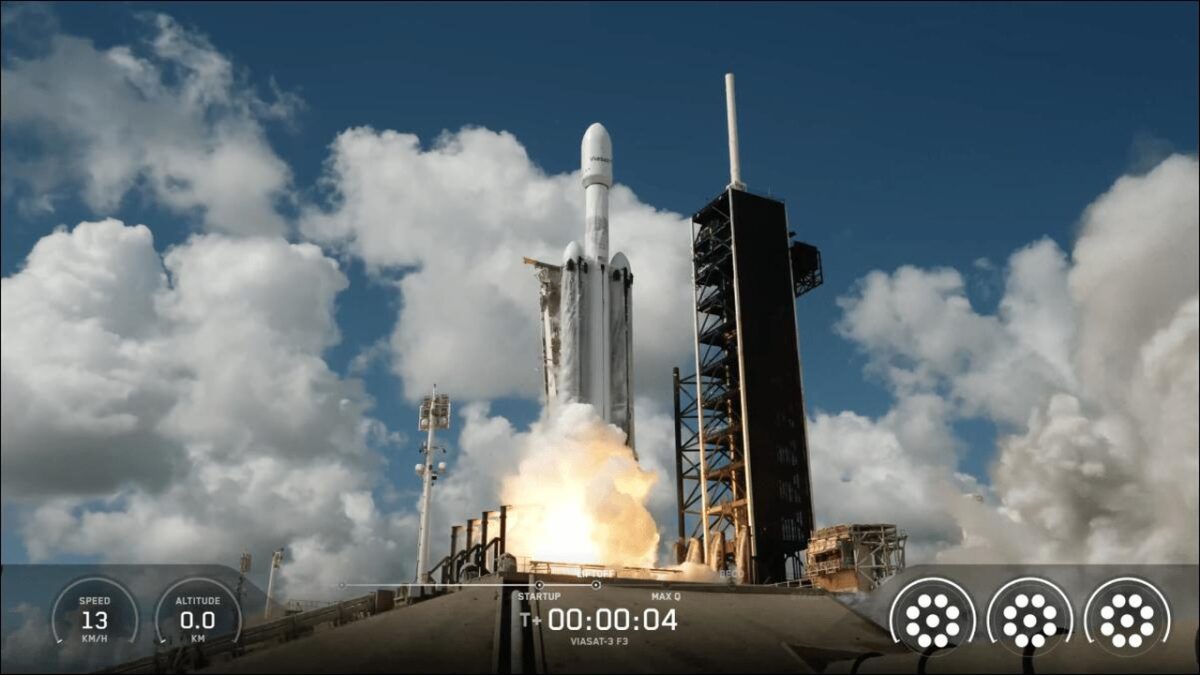
The third and final satellite, Viasat-3 F3, was successfully launched on April 29, 2026, aboard a powerful SpaceX Falcon Heavy rocket. Following a spectacular ascent, the six-tonne telecommunications relay satellite was precisely delivered into its geosynchronous orbit. This launch is particularly significant as Viasat-3 F3 is dedicated to extending high-speed, high-capacity coverage specifically to the Asia-Pacific region, completing the constellation’s intended global reach. The successful deployment of Viasat-3 F3 directly contributes to Inmarsat’s strengthened Pacific coverage, leveraging the advanced capabilities of this satellite to enhance connectivity for a vast number of maritime routes and remote communities. The integration of this final satellite into Inmarsat’s evolving multi-orbit network solidifies the comprehensive global broadband solution promised by the partnership.
Unlocking Unprecedented Digital Capabilities at Sea
The enhanced high-speed Pacific coverage enabled by Viasat-3 F3, combined with a purpose-built terminal designed to seamlessly integrate with this next-generation satellite infrastructure, presents a myriad of opportunities for the maritime industry. For shipping companies, this means the ability to implement sophisticated Internet of Things (IoT) solutions across their fleets, collecting vast amounts of data from sensors on engines, cargo, and navigation systems. This real-time data can be used for predictive maintenance, preventing costly breakdowns, and optimizing voyages to reduce fuel consumption and environmental impact. The speed and reliability of the new network are critical for these data-intensive applications, ensuring that information flows freely and without interruption.
Beyond operational benefits, robust connectivity supports enhanced safety and security at sea. Vessels can now access high-definition weather forecasting services, sophisticated navigation charts, and communicate with shore-based emergency services more effectively. The ability to quickly transmit large data files, conduct high-quality video conferencing, and utilize advanced cloud-based applications transforms the onboard environment into a truly connected workspace. This digital transformation extends to administrative tasks, crew training, and even telemedicine, ensuring that vessels are not just moving assets but fully integrated digital hubs. The synergy between Inmarsat’s existing L-band and Ka-band services and Viasat-3’s Ka-band capacity creates a resilient, layered network, ensuring maritime users always have access to the best available connectivity solution, even in the most challenging conditions.
For offshore energy platforms and fishing fleets operating in the vast Pacific, upgraded connectivity provides essential links for operational control, crew communications, and data transmission. These sectors often operate in highly remote areas where traditional communication infrastructure is non-existent. Viasat-3 F3’s enhanced Pacific coverage bridges this gap, enabling critical real-time monitoring of equipment, secure data transfers for exploration and production activities, and maintaining robust communication channels for personnel. This level of reliable, high-speed connectivity is vital for ensuring safety, maximizing productivity, and supporting the continuous operation of critical maritime and offshore assets.
The Future of Global Maritime Communications
The successful deployment of the entire Viasat-3 constellation, particularly its expansion into the Asia-Pacific region, marks a pivotal moment for Inmarsat and its vision for global maritime communications. This infrastructure is not merely about faster internet; it’s about enabling the next generation of digital services that will drive efficiency, safety, and sustainability across the entire maritime ecosystem. The partnership between Inmarsat and Viasat exemplifies a collaborative approach to solving complex connectivity challenges, leveraging complementary technologies to create a truly global, multi-layered network. This hybrid network approach, combining the strengths of geostationary (GEO) and eventually low Earth orbit (LEO) constellations, promises unparalleled resilience and performance for maritime users worldwide.
Looking ahead, the ongoing integration of Viasat-3’s high-capacity capabilities into Inmarsat’s existing network will continue to unfold, with further optimizations and service enhancements expected. The focus will remain on delivering a seamless user experience, adapting to the evolving needs of the maritime industry, and supporting its journey towards greater digitalization. This includes developing advanced cybersecurity measures to protect critical operational data and exploring innovative applications that leverage the full potential of high-speed, always-on connectivity at sea. The commitment to innovation ensures that Inmarsat and Viasat will remain at the forefront of providing cutting-edge satellite communication solutions for the global fleet.
The enhanced high-speed Pacific coverage offered by the Viasat-3 F3 launch positions Inmarsat to better serve the dynamic and rapidly growing maritime markets in Asia and Oceania. As vessels become more connected, autonomous, and data-driven, the demand for robust, reliable, and high-capacity satellite broadband will only intensify. The successful deployment of Viasat-3 F3 is a testament to technological progress and a clear indicator of the transformative power of advanced satellite communications for the maritime world. This is an invitation for maritime stakeholders to explore the advanced capabilities now available and leverage this enhanced connectivity to drive their own innovation and operational excellence.