EPS Wind-Assisted Tanker Sails to Singapore Maritime Week | Mariner News
The maritime industry is undergoing a profound shift towards sustainability. Eastern Pacific Shipping (EPS) leads this transformation with its innovative wind-assisted tanker, the Pacific Sunstone. Its maiden voyage to Singapore, coinciding with Singapore Maritime Week (SMW), highlights the city-state’s crucial role in maritime innovation and decarbonisation. This event showcases tangible progress in reducing shipping’s environmental footprint, charting a greener future for global commerce.
A New Era for Sustainable Shipping: Pacific Sunstone’s Arrival
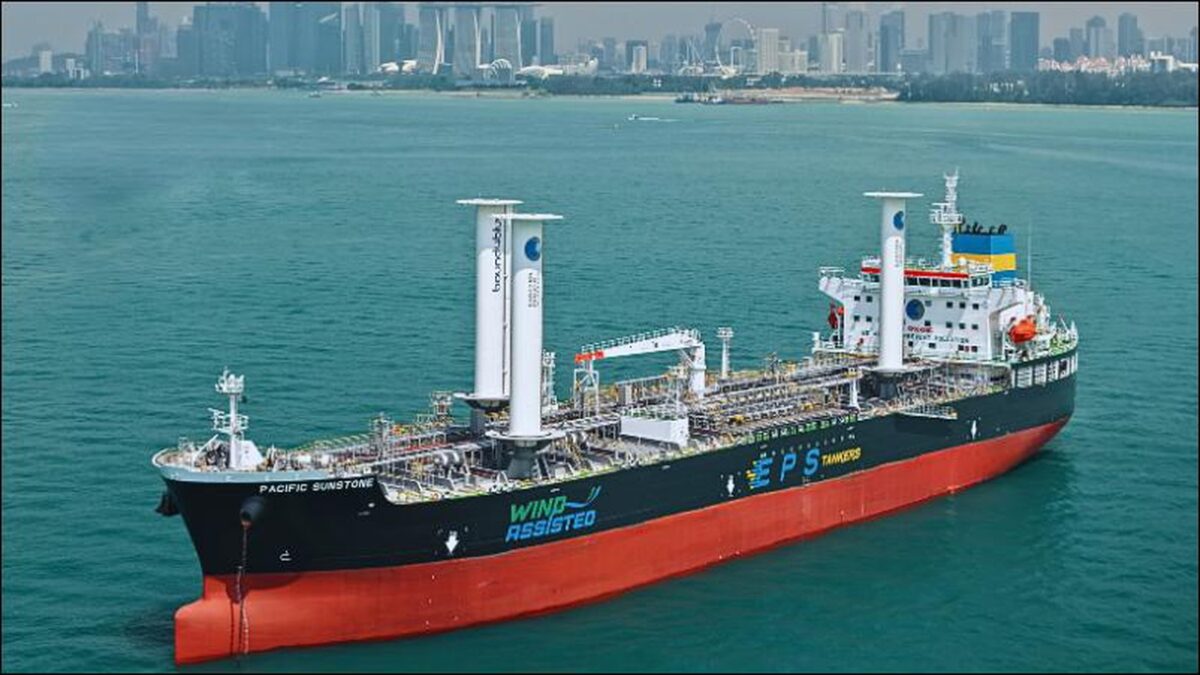
The MR tanker Pacific Sunstone recently made its historic entry into Singapore, delivered from New Times Shipbuilding in China. This vessel marks a significant advancement in sustainable shipping. It features three 22-metre bound4blue eSAIL suction sails, EPS’s second deployment of advanced wind-assisted propulsion technology and its pioneering integration on a newbuild vessel. This strategic move by EPS underscores a bold commitment to both environmental benefits and operational efficiencies.
Integrating wind propulsion on a modern tanker sets a clear course for maritime transport. By harnessing wind energy, the vessel significantly reduces fossil fuel reliance and greenhouse gas emissions—crucial for industry decarbonisation. The Pacific Sunstone’s arrival during Singapore Maritime Week allowed leaders to witness progress firsthand, reinforcing Singapore’s status as a hub for maritime innovation and green technology.
Pioneering Wind-Assisted Propulsion for Enhanced Fuel Efficiency
The Pacific Sunstone’s innovation centres on its bound4blue eSAIL suction sails, designed for highly efficient wind energy capture. These rigid sails generate powerful aerodynamic thrust, directly supplementing the main engines. Automated deployment and retraction optimize performance across diverse wind conditions, maximizing fuel efficiency. This system represents a significant advancement in leveraging natural forces for propulsion, embodying cutting-edge clean technology.
Benefits of wind-assisted propulsion technology are substantial: marked reductions in fuel consumption, lower operational costs, and crucial decreases in harmful emissions like CO2, NOx, and SOx. This aligns with IMO’s ambitious targets for emissions reduction. For a wind-assisted tanker like the Pacific Sunstone, these systems are integral to its green operational strategy, contributing significantly to a reduced carbon footprint and global maritime decarbonisation.
Singapore: A Global Nexus for Maritime Decarbonisation
Singapore’s strategic position and progressive policies have cemented its reputation as a global maritime hub. The Pacific Sunstone’s arrival during Singapore Maritime Week symbolically reinforced the city-state’s proactive stance in driving maritime decarbonisation. SMW serves as a vital platform for stakeholders to converge, exchange ideas, and forge partnerships for greener shipping solutions, showcasing Singapore’s commitment to maritime innovation and sustainability leadership.
Collaboration is pivotal to Singapore’s green maritime future. EPS’s partnership with Yinson GreenTech’s marinEV on electric vessel trials exemplifies a broader commitment to diverse alternative energy sources. This multi-pronged strategy, embracing wind propulsion, alternative fuels, and electric technologies, demonstrates a holistic approach to reducing environmental impact. Singapore’s robust R&D infrastructure and strong government support provide fertile ground for such advancements, creating an unparalleled environment for accelerating sustainable shipping.
Eastern Pacific Shipping’s Commitment to Green Operations
Eastern Pacific Shipping (EPS) consistently demonstrates a strong commitment to environmental stewardship. The deployment of the wind-assisted tanker Pacific Sunstone reflects EPS’s comprehensive strategy for green operations. This strategy includes significant investments in clean technology and alternative fuel solutions, such as dual-fuel vessels running on LNG, LPG, and methanol. This proactive approach highlights their readiness to lead maritime decarbonisation across its diverse fleet.
EPS’s philosophy prioritizes exploring all viable pathways to reduce its environmental footprint. Their investment in wind-assisted propulsion complements broader sector progress, including advancements in alternative fuels and initiatives for greener operations. By diversifying green solutions, EPS minimizes risk and maximizes potential for substantial emissions reduction across its fleet, ensuring a resilient and sustainable business model for the long term. This leadership extends to advocating industry-wide collaboration and knowledge sharing for true sustainable shipping.
Charting a Greener Horizon: The Future of Maritime Transport
The maiden voyage of EPS’s wind-assisted tanker, Pacific Sunstone, marks a pivotal moment, symbolizing accelerating momentum towards a greener maritime future. This event signifies a broader industry shift where maritime innovation directly correlates with environmental responsibility. The successful integration of bound4blue eSAIL technology demonstrates the commercial viability of green technology solutions, offering a tangible pathway to significantly reduce emissions reduction and enhance fuel efficiency across global fleets.
However, the journey towards comprehensive maritime decarbonisation faces significant challenges, including scaling alternative fuel production, developing robust bunkering infrastructure, and harmonizing international regulations. Yet, successes from pioneers like EPS, and the collaborative spirit fostered at events like Singapore Maritime Week, instill optimism. Innovation holds immense potential to overcome these challenges, transforming them into opportunities for sustainable development and driving a greener future for global commerce.