Bound4blue Powers Maersk Tankers with Wind Propulsion | Mariner News
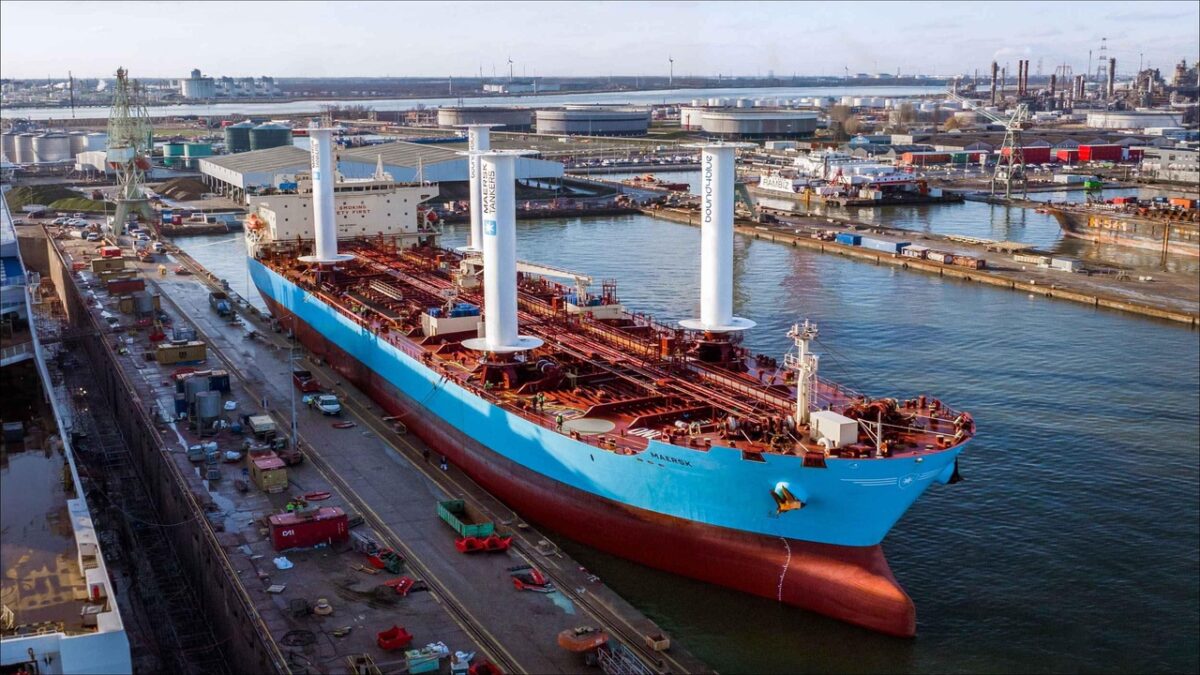
In a significant leap towards global maritime decarbonization, Bound4blue, a pioneering force in wind propulsion technology, has successfully completed its second cutting-edge eSAILs installation for Maersk Tankers. This pivotal achievement underscores the increasing momentum behind sustainable shipping practices and highlights the tangible benefits of integrating modern wind-assisted propulsion systems into commercial fleets. The latest installation involved outfitting the tanker Maersk Tahiti with four state-of-the-art 24-meter suction sails, meticulously fitted at the renowned Chengxi Shipyard in Jiangyin, China. This deployment marks another crucial milestone in the ambitious five-tanker agreement between Bound4blue and Maersk Tankers, a partnership poised to redefine fuel efficiency and environmental performance across the industry. The successful integration of these innovative wind propulsion units on the Maersk Tahiti follows an earlier triumph in January with the Maersk Trieste, solidifying the commitment of both entities to fostering a greener future for global shipping. As the maritime sector faces mounting pressure to reduce its carbon footprint, such advancements are not merely technological feats but essential steps towards achieving a more sustainable and economically viable operational model. This initiative positions Bound4blue and Maersk Tankers at the forefront of the green shipping revolution, demonstrating a clear pathway to significant reductions in fuel consumption and greenhouse gas emissions.
Unveiling Bound4blue’s Suction Sail Technology for Sustainable Shipping
The core of Bound4blue’s innovative approach lies in its patented suction sail technology, known as eSAILs. These aren’t your traditional canvas sails; instead, they leverage the Magnus effect to generate substantial thrust, effectively supplementing the vessel’s main engine. Each of the four 24-meter eSAIL units installed on the Maersk Tahiti operates by creating a pressure differential around a rotating cylindrical surface, resulting in a powerful aerodynamic force that propels the ship forward. This sophisticated design is engineered to deliver double-digit fuel savings, a critical factor for shipping companies grappling with volatile fuel prices and the imperative to optimize operational costs. The installation process itself at Chengxi Shipyard represents a marvel of modern engineering, integrating complex aerodynamic structures onto existing tanker designs with precision and efficiency. The strategic choice of Chengxi Shipyard, a leading facility in China, further highlights the global nature of this collaborative effort to advance clean maritime technology.
Beyond the immediate economic advantages, the environmental impact of these suction sails is profound. By reducing the engine load, the eSAILs directly contribute to a significant decrease in harmful emissions, including carbon dioxide (CO2), sulfur oxides (SOx), and nitrogen oxides (NOx). This reduction in greenhouse gas emissions is not just beneficial for the planet but also crucial for improving a vessel’s Carbon Intensity Indicator (CII) performance – a key metric under international maritime regulations. A better CII rating translates to enhanced compliance and a stronger environmental profile, factors that are increasingly important for charterers and stakeholders. The technology thus offers a comprehensive solution that addresses both the financial and ecological pressures facing the contemporary shipping industry, making wind-assisted propulsion an increasingly attractive and viable option for companies committed to environmental stewardship and operational excellence. The deployment of such innovative systems on vessels like the Maersk Tahiti paves the way for a new era of eco-friendly maritime solutions, setting a benchmark for future vessel designs and retrofits across the global fleet.
Maersk Tankers’ Strategic Investment in Wind-Assisted Propulsion
The partnership between Bound4blue and Maersk Tankers is more than just a series of installations; it represents a strategic, long-term commitment by a major industry player to embrace advanced wind-assisted propulsion. The five-tanker agreement, which envisions the deployment of a total of 20 eSAIL units across the fleet, underscores Maersk Tankers’ dedication to leading the charge in maritime decarbonization. This extensive rollout signifies a bold investment in future-proof technologies that promise not only environmental dividends but also a distinct competitive advantage. The prior success with the Maersk Trieste, which began operations with its eSAILs in January, provided invaluable data and operational insights, building confidence for the subsequent installations. This phased approach allows for continuous learning and optimization, ensuring that each subsequent vessel benefits from refined processes and enhanced performance, further solidifying the case for wind propulsion on a broader scale. Maersk Tankers’ proactive stance demonstrates a forward-thinking approach to sustainable operations, reflecting an understanding that early adoption of green technologies can yield substantial returns in the long run.
This visionary collaboration is driven by a deep understanding of the evolving landscape of global shipping, where environmental regulations are tightening and stakeholder expectations for sustainability are escalating. By integrating Bound4blue’s wind propulsion systems, Maersk Tankers is actively working to reduce its fleet’s overall environmental footprint, positioning itself as a leader in clean shipping. The decision to invest heavily in wind power aligns with global efforts to transition towards a low-carbon economy, showcasing a tangible commitment to corporate social responsibility. Furthermore, this move is likely to appeal to environmentally conscious cargo owners and charterers who increasingly prioritize greener shipping options. The ability to offer vessels with demonstrably lower emissions can translate into premium contracts and strengthened market relationships, making the investment in eSAILs a sound business decision that extends beyond immediate fuel savings. The partnership exemplifies how innovation and collaboration can drive meaningful change within an industry pivotal to global trade.
Navigating Regulatory Compliance and Boosting Commercial Appeal
One of the most compelling aspects of adopting wind-assisted propulsion systems like Bound4blue’s eSAILs is their significant role in helping shipping companies navigate the complex and increasingly stringent regulatory landscape. International bodies and regional authorities are continually introducing measures aimed at curbing maritime emissions, and technologies that offer quantifiable reductions are becoming indispensable. For instance, the European Union’s FuelEU Maritime initiative specifically recognizes and incentivizes the use of wind-assisted propulsion, offering a clear regulatory advantage to vessels equipped with such systems. This recognition means that ships utilizing eSAILs can more easily meet compliance targets, avoiding potential penalties and fostering a smoother operational environment within EU waters. The strategic benefit of these systems in the context of emerging regulations cannot be overstated, as they provide a practical and effective means for fleets to stay ahead of the curve in environmental performance and regulatory adherence.
Furthermore, the financial implications of the EU Emissions Trading System (EU ETS) are a growing concern for shipowners operating in European waters. Under this cap-and-trade scheme, emissions above a certain threshold incur significant costs, directly impacting a vessel’s profitability. Wind propulsion systems, by substantially reducing fuel consumption and associated emissions, directly lower a vessel’s exposure to EU ETS costs. This translates into tangible financial savings, adding another layer of commercial appeal to these innovative technologies. The combined effect of improved CII ratings, compliance with FuelEU Maritime, and reduced EU ETS exposure creates a powerful economic incentive for shipowners to invest in clean maritime technology. Beyond regulatory compliance and cost avoidance, the adoption of advanced wind propulsion also enhances a company’s brand image and market reputation, attracting environmentally conscious clients and investors. As José Miguel Bermúdez, CEO of Bound4blue, rightly observed, “The agreement with Maersk Tankers reflects the wider scaling up of wind power adoption across the industry,” underscoring a broader industry trend towards embracing renewable energy solutions at sea for sustained commercial viability and environmental stewardship.
The Broader Horizon: Wind Propulsion’s Role in Maritime Decarbonization
The successful deployment of eSAILs on the Maersk Tahiti and Maersk Trieste marks a significant chapter in the ongoing narrative of maritime decarbonization. The global shipping industry is under immense pressure to meet ambitious climate targets, with organizations like the International Maritime Organization (IMO) pushing for substantial reductions in greenhouse gas emissions in the coming decades. Wind propulsion, once considered a relic of the past, is re-emerging as a highly effective and readily available solution, modernized with cutting-edge technology and intelligent control systems. It stands as a viable, carbon-neutral power source that can be integrated with existing vessel designs and future propulsion systems, contributing significantly to a comprehensive strategy for clean shipping. The increasing adoption of systems like Bound4blue’s eSAILs signals a fundamental shift in how the industry perceives and approaches energy efficiency, moving beyond incremental improvements to embracing truly transformative technologies. This shift is critical for achieving a sustainable maritime future that balances environmental responsibility with economic necessity, paving the way for a more resilient and eco-friendly global supply chain.
The ongoing commitment by major players like Maersk Tankers to integrate wind propulsion underscores a growing recognition that innovative renewable energy solutions are not just an aspiration but a necessity. As the industry explores alternative fuels like ammonia, methanol, and hydrogen, wind assistance offers an immediate, proven pathway to reduce emissions today, complementing future fuel strategies. The expansion of Bound4blue’s technology across five tankers is indicative of a broader industry trend towards embracing diverse decarbonization pathways. This includes not only technological retrofits but also a change in operational paradigms, where factors like weather routing and vessel optimization are integrated with wind power to maximize fuel savings and minimize environmental impact. The success of these installations sends a clear message to the wider shipping community: wind propulsion is a mature, reliable, and highly effective tool in the quest for maritime sustainability. It represents a tangible step towards realizing a future where the oceans are traversed by a fleet that is both efficient and environmentally responsible, solidifying wind’s critical role in the global shipping decarbonization agenda.