QatarEnergy LNG Halts After Attacks: Market Impact | Mariner News
The global energy landscape is currently grappling with significant upheaval following the critical announcement of a QatarEnergy LNG production halt. This sudden cessation of liquefied natural gas (LNG) output comes in direct response to targeted military attacks on key operating facilities located within Ras Laffan Industrial City and Mesaieed Industrial City in the State of Qatar. As one of the world’s leading LNG producers, responsible for approximately 20% of the planet’s total LNG output, this development has immediately sent shockwaves across the international energy markets, with the Platts JKM Asian LNG benchmark experiencing an unprecedented jump of almost 41% to $15.07/MMBtu shortly after the news broke. The implications of this `LNG supply disruption` are profound, affecting not only natural gas prices but also broader energy security, international trade routes, and the intricate dynamics of the global energy market.
Qatar’s Pivotal Role in Global LNG Supply
Qatar has long established itself as an indispensable pillar of the global natural gas market, leveraging its vast reserves to become a top exporter of liquefied natural gas. The nation’s energy infrastructure, particularly the immense facilities at Ras Laffan and Mesaieed, are critical nodes in the global energy supply chain. Ras Laffan Industrial City, in particular, hosts the world’s largest LNG plant, making any operational disruption there a truly significant market event with far-reaching consequences. The strategic importance of Qatar’s energy exports extends across continents, supplying vital natural gas to Europe, Asia, and other regions, underpinning industrial operations, power generation, and residential heating.
This position as a global energy powerhouse means that a `QatarEnergy LNG production halt` is not merely a localized incident; it triggers a cascade of effects that resonate through every facet of the international energy sector. The reliability of Qatari LNG has historically been a stabilizing factor in a volatile market, and its sudden absence creates a void that cannot be easily or quickly filled by other producers. Understanding QatarEnergy’s immense contribution to energy supply is crucial for appreciating the gravity of the current situation and the subsequent market anxieties it has generated.
The Attacks and Immediate Market Reaction
According to QatarEnergy’s press release, the decision to cease production of LNG and associated products was a direct consequence of the military attacks on its operating facilities. While the company’s statement left some ambiguity regarding the precise scope of the shutdown—whether it encompasses all facilities or a limited number of production trains—the immediate market reaction underscores the perceived severity. Regardless of the exact scale, any significant reduction from a producer of Qatar’s magnitude inevitably triggers intense market speculation and price surges, highlighting the fragility of global `energy supply` chains.
Following the announcement, the Platts JKM Asian LNG benchmark’s dramatic increase by nearly 41% on Monday serves as a stark indicator of the immediate pressure on `natural gas prices`. This benchmark is a crucial gauge of spot LNG prices in Asia, and its sharp ascent signals heightened concern among buyers regarding future supply availability and cost. Such a sudden hike in prices can lead to a scramble for alternative supplies, potentially escalating costs further for consumers and industries reliant on stable energy imports. The market’s swift and pronounced response illustrates the critical role `QatarEnergy` plays in maintaining global `LNG market` equilibrium.
Ripple Effects Across the Global Energy Market
The `LNG supply disruption` from Qatar has far-reaching implications that extend beyond immediate price spikes. Nations heavily dependent on Qatari LNG, particularly in Europe and Asia, now face heightened `energy security` concerns. Europe, which has increasingly diversified its natural gas sources post-conflict, may find its efforts challenged if a significant portion of its LNG imports becomes uncertain. This situation could reignite discussions about energy independence, strategic reserves, and the accelerated development of renewable energy sources to mitigate future vulnerabilities.
For Asian markets, which are already highly competitive for LNG cargoes, the impact is particularly acute. The JKM benchmark’s surge reflects this intensity, signaling potential energy crises for industrial sectors and utility providers across the continent. This scenario could lead to a redirection of existing LNG cargoes, a bidding war for available spot volumes, and a reassessment of long-term `energy contracts`. Furthermore, disruptions in natural gas can indirectly affect other `energy commodities`, such as crude oil, as market participants seek substitutes or hedge against broader energy market volatility.
Impact on the Shipping Industry and Bunker Markets
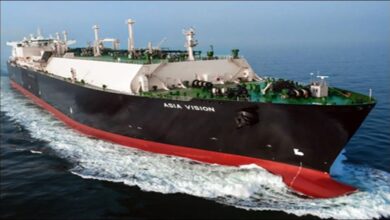
The `QatarEnergy LNG production halt` also casts a significant shadow over the `shipping industry`. Qatar is a major hub for LNG carrier traffic, and a prolonged shutdown could lead to a temporary decrease in demand for these specialized vessels. LNG carriers are purpose-built for transporting liquefied natural gas, and any reduction in cargo availability from a key loading port like Ras Laffan necessitates re-evaluation of `maritime logistics` and `trade routes`. Shipping companies with long-term contracts for Qatari LNG may need to seek alternative employment for their fleet, impacting freight rates and vessel utilization globally.
Moreover, the broader increase in `global energy prices`, driven by the `natural gas market` volatility, will inevitably translate into higher operating costs for the entire shipping sector. While LNG as a marine fuel is a growing trend, the immediate concern lies with `bunker fuel prices` for conventional fuels like very low sulphur fuel oil (VLSFO) and high sulphur fuel oil (HSFO). Higher energy prices generally correlate with increased fuel costs, eroding profit margins for container ships, bulk carriers, and tankers alike. The `bunker market impact` could lead to additional inflationary pressures on global supply chains, affecting the cost of goods transportation worldwide and potentially delaying the adoption of LNG as a bunker fuel due to supply uncertainties and price volatility.
Geopolitical Ramifications and Energy Security
Beyond economic immediate effects, the attacks on QatarEnergy’s facilities underscore the inherent vulnerabilities of critical `energy infrastructure` in an increasingly volatile geopolitical landscape. Such incidents highlight the imperative for nations to bolster `energy security` strategies and foster `supply chain resilience`. The specific nature of the military attacks also raises serious geopolitical concerns, potentially escalating regional tensions and prompting international calls for de-escalation and protection of vital global assets. The stability of `global energy security` hinges on the uninterrupted flow of resources, making attacks on energy facilities a matter of international concern.
Governments and international organizations will undoubtedly intensify efforts to assess `geopolitical risk` in key energy-producing regions and implement measures to safeguard `energy supply` routes. This event could serve as a catalyst for renewed diplomatic efforts, as well as a reassessment of international partnerships and security arrangements designed to protect `maritime trade` and critical infrastructure. The incident reinforces the need for strategic diversification of energy sources and transport routes to minimize dependency on single points of failure, thereby enhancing collective `energy resilience` against future shocks.
Future Outlook and Recovery Efforts
The duration and scope of the `QatarEnergy LNG production halt` remain critical unknowns, creating considerable uncertainty for the `global LNG market`. QatarEnergy has affirmed its commitment to communicating the latest available information to its stakeholders, a crucial step in managing market expectations and investor confidence. The company’s ability to quickly restore production will be paramount in mitigating the long-term impact on global `natural gas prices` and `energy supply` stability. The situation also places a spotlight on other global LNG suppliers, such as the United States, Australia, and Russia, whose production capacities and flexibility will be closely scrutinized as the market seeks to rebalance.
In the coming weeks and months, the `energy market` will keenly observe QatarEnergy’s recovery efforts, looking for clear timelines and assurances regarding the full resumption of operations. Long-term strategic adjustments by importing nations, including investments in domestic energy production, renewable technologies, and enhanced energy storage capabilities, may accelerate in response to this `energy crisis`. The `global LNG market` will remain highly sensitive to any further developments, with ongoing vigilance required from all participants to navigate the evolving landscape of `energy security` and `market volatility` in the wake of this significant disruption.
The `QatarEnergy LNG production halt` due to military attacks represents a profound challenge to `global energy security` and the stability of the `natural gas market`. The immediate surge in `natural gas prices` and the uncertainty surrounding future `LNG supply` from a critical exporter have set off alarm bells worldwide. As the `shipping industry` grapples with potential `bunker market impact` and rerouted `maritime logistics`, and nations reassess their `energy security` strategies, the international community watches closely. The path forward will require robust recovery efforts from QatarEnergy and concerted international cooperation to safeguard `energy supply` chains and mitigate the broader `geopolitical risk` in the ever-interconnected `global energy market`.