Greenpeace Protests Rosebank Oil Field FPSO in Scotland | Mariner News
Greenpeace activists have once again positioned themselves at the forefront of the global climate crisis, intensifying their direct action against a major UK oil and gas project. In a bold demonstration that has captured international attention, environmental campaigners from Greenpeace confronted a floating production storage and offloading (FPSO) vessel, the PetroJarl Rosebank, as it navigated towards its ultimate destination: Scotland’s controversial Rosebank Oil Field. This high-stakes confrontation underscores the escalating tensions between fossil fuel development and urgent climate action, unfolding as the project simultaneously faces critical debate within the UK parliament. The activists’ dramatic intervention served as a powerful visual statement, bringing the contentious offshore drilling project directly into the public consciousness and highlighting the deep divisions over the UK’s energy future.
The Rosebank Oil Field: A Flashpoint in Climate Debate
The Rosebank Oil Field, situated off the coast of the Shetland Islands on the UK Continental Shelf, represents one of the largest undeveloped oil and gas reserves in the North Sea. Operated by a consortium including oil majors Equinor, Shell, and Ithaca Energy, the project holds an estimated 500 million barrels of oil equivalent. Proponents argue that developing Rosebank is crucial for bolstering the UK’s energy security, reducing reliance on volatile international markets, and securing jobs within the vital offshore industry. They emphasize the economic benefits and the role it could play in meeting domestic energy demand during the transition to renewables.
However, environmental organizations, led by Greenpeace, vehemently oppose the Rosebank development. They contend that greenlighting new fossil fuel projects directly contradicts the UK’s legally binding climate commitments, particularly its net-zero emissions target by 2050. Scientists warn that approving new oil and gas extraction makes it virtually impossible to limit global warming to 1.5 degrees Celsius, pushing the planet closer to irreversible climate tipping points. The debate over Rosebank is thus not merely about energy production; it is a profound discussion about the UK’s moral and environmental leadership on the world stage and its commitment to a sustainable future.
The project’s approval history itself is contentious. While initially greenlit by the previous UK government, the decision has come under renewed scrutiny and fierce debate within the current Labour government. This parliamentary discussion highlights the complex political landscape surrounding energy policy, where economic imperatives often clash with ecological imperatives. The future of Rosebank hangs in the balance, a symbol of the broader global struggle to reconcile economic development with environmental protection amidst a rapidly changing climate.
Greenpeace’s Audacious Marine Action
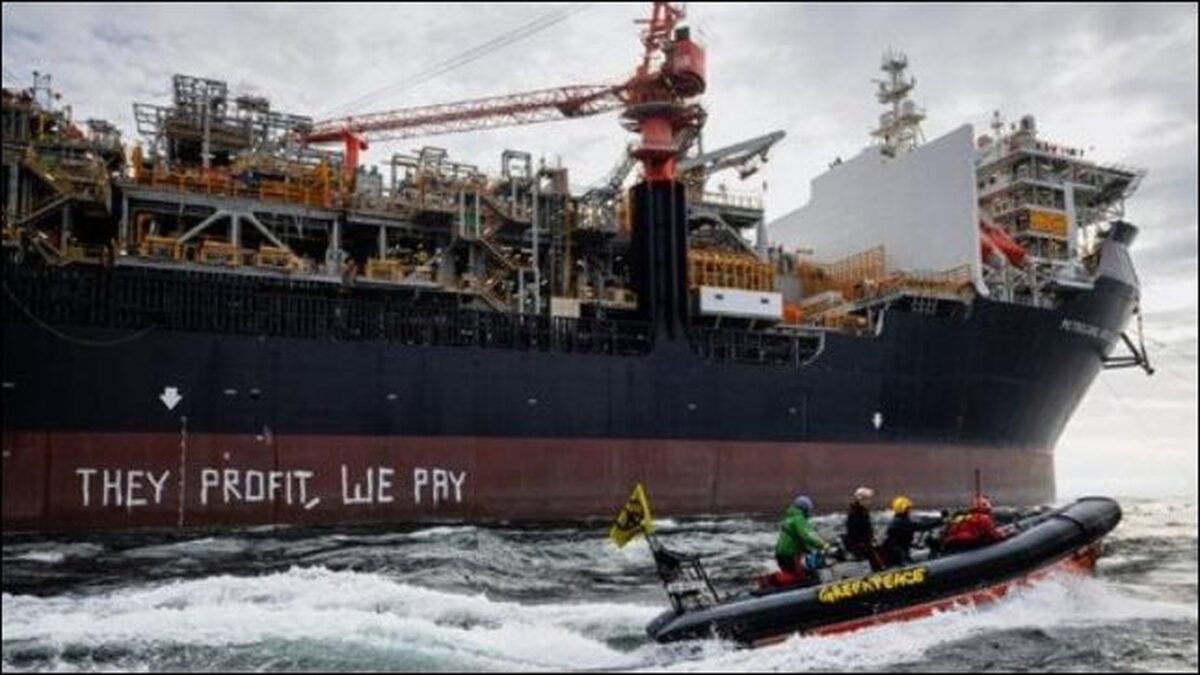
The recent confrontation orchestrated by Greenpeace was meticulously planned and executed. Utilizing their iconic vessel, the Rainbow Warrior III, activists tracked the PetroJarl Rosebank FPSO, a massive floating facility designed to extract, process, and store oil and gas. The FPSO had made a stop for refueling in Walvis Bay, Namibia, a strategic location that allowed Greenpeace to intercept it before its final leg to the North Sea. This tactical decision amplified the protest’s visibility, extending its reach beyond UK waters.
Once in proximity, four determined activists launched from the Rainbow Warrior III in rigid-hulled inflatable boats (RHIBs) and kayaks, navigating treacherous waters to reach the colossal FPSO. In a daring act of direct action, they managed to paint the stark, defiant slogan ‘they profit, we pay’ onto the vessel’s hull. This powerful message directly challenged the perceived corporate greed associated with fossil fuel extraction, contrasting it with the environmental and societal costs borne by the public.
Simultaneously, a larger contingent of six activists encircled the FPSO, deploying large banners that unequivocally declared their opposition to the project. The Rainbow Warrior III itself amplified the message, displaying a giant banner strung between its masts emblazoned with “Stop Rosebank.” This multi-pronged approach created an unmissable spectacle, ensuring that the environmental protest against the oil field received widespread media coverage and public attention. It also marked the second time in just five days that Greenpeace activists had targeted the PetroJarl Rosebank, demonstrating their unwavering commitment and escalating their campaign against new offshore drilling.
The Broader Crusade Against Fossil Fuel Expansion
Greenpeace’s actions against the Rosebank Oil Field are not isolated incidents but rather part of a much larger, global crusade by environmental groups to halt the expansion of fossil fuel projects worldwide. This movement is rooted in the scientific consensus that new oil and gas developments are incompatible with the goals of the Paris Agreement. Activists argue that the world already possesses more proven fossil fuel reserves than can be safely burned if global temperature rise is to be limited to acceptable levels. Therefore, every new project, such as Rosebank, represents a step backward in the fight against climate change.
The call for an immediate and just transition away from coal, oil, and gas is growing louder from various sectors, including international organizations, indigenous communities, and climate-vulnerable nations. These voices emphasize the need to divest from fossil fuels and rapidly accelerate investment in renewable energy sources like wind, solar, and tidal power. They highlight the paradox of wealthy nations continuing to approve new hydrocarbon extraction while simultaneously advocating for climate leadership and supporting developing nations in their decarbonization efforts. The Rosebank project, therefore, has become a microcosm of this global energy debate, testing the resolve of governments and the influence of powerful corporate interests against the rising tide of environmental awareness and activism.
Furthermore, critics question the long-term economic viability of such projects in a rapidly decarbonizing world. With the increasing competitiveness of renewable energy technologies and the growing pressure from investors for sustainable portfolios, many analysts predict a future where demand for fossil fuels significantly diminishes. Investing billions in new oil and gas infrastructure, which has an operational lifespan of decades, could lead to stranded assets, posing financial risks to companies and taxpayers alike. This economic argument further strengthens the environmental case against new oil and gas developments, urging a strategic pivot towards a green economy that offers more secure and sustainable employment opportunities.
Environmental and Socioeconomic Implications of Offshore Drilling
The development of the Rosebank Oil Field carries significant environmental and socioeconomic implications that extend beyond just carbon emissions. Offshore drilling operations inherently pose risks to marine ecosystems. Potential oil spills, even minor ones, can have devastating impacts on sensitive marine life, seabirds, and coastal habitats, disrupting delicate food webs and impacting biodiversity. The North Sea, already a heavily industrialized marine environment, supports diverse species and critical fishing grounds. Any new extraction activities add further pressure to this already strained ecosystem.
Beyond the immediate risks, the extraction and burning of the oil and gas from Rosebank would contribute millions of tons of carbon dioxide to the atmosphere over its operational lifetime. This significant contribution would undermine the UK’s climate targets and diminish its credibility on the international stage, especially as it seeks to influence other nations to reduce their emissions. Environmental groups consistently point out this hypocrisy, arguing that true climate leadership requires leading by example, not by expanding fossil fuel infrastructure.
From a socioeconomic perspective, while proponents emphasize job creation and economic benefits, critics argue these are often short-term gains that detract from investing in more sustainable, future-proof industries. A just transition framework, advocated by many environmental and social justice organizations, calls for retraining and reskilling workers from the fossil fuel sector to transition into the burgeoning renewable energy industry. This approach aims to protect livelihoods while achieving environmental goals, ensuring that the shift away from fossil fuels is equitable and leaves no community behind. The debate over Rosebank highlights the urgent need for comprehensive energy planning that considers both economic prosperity and ecological responsibility.
The Path Forward: A Crucial Juncture for UK Energy Policy
The ongoing parliamentary debate surrounding the Rosebank Oil Field represents a crucial juncture for UK energy policy and its climate ambitions. The decision regarding whether to grant final approval for the project will send a powerful signal about the government’s commitment to its net-zero targets and its willingness to challenge the status quo of fossil fuel dependency. Public pressure, amplified by Greenpeace’s highly visible direct action, will undoubtedly play a significant role in shaping this outcome.
The conversation extends beyond Rosebank, influencing the perception and viability of other potential oil and gas projects in the UK Continental Shelf. A decision to halt Rosebank could set a precedent, signaling a stronger pivot towards renewable energy and a definitive move away from new fossil fuel exploration. Conversely, approving it might embolden further such developments, locking the UK into a fossil fuel trajectory that climate scientists warn is unsustainable.
Ultimately, the future of energy in the UK, and indeed globally, hinges on bold leadership and strategic investment in sustainable alternatives. The confrontation at the Rosebank Oil Field is more than just a protest; it is a critical moment in the ongoing struggle for climate justice, urging societies to re-evaluate their relationship with fossil fuels and accelerate the transition towards a truly green and resilient energy future. The coming months will reveal whether the UK government prioritizes short-term energy security through fossil fuels or embraces a long-term vision of a decarbonized economy, aligning its actions with its stated climate ambitions. The world watches as the fate of Rosebank, and perhaps the pace of the global energy transition, unfolds.