Cargo Ship Fire Medevac: HM Coastguard & RNLI Act | Mariner News
In a dramatic display of coordinated maritime rescue, the HM Coastguard and the Royal National Lifeboat Institution (RNLI) successfully executed a critical medevac operation following a `cargo ship fire` in the bustling English Channel. This incident, unfolding on April 8, underscored the inherent dangers of sea travel and the invaluable role of dedicated emergency services in safeguarding `seafarer safety`. The rapid response ensured immediate medical attention for an injured crewmember, highlighting the seamless collaboration between various agencies tasked with managing `marine emergencies`.
The English Channel, one of the world’s busiest shipping lanes, became the scene of urgent action when the RDJ Waalstroom, a 2,650 dwt Dutch-owned cargo ship, issued a frantic mayday call. The vessel, built in 2003 and measuring 90 meters (295 feet) in length, reported an `engine room fire` while transiting near Portsmouth, England. With a crew of six aboard and registered in Antigua and Barbuda, the ship was en route to Balboa, Spain, when the critical `vessel fire` erupted. The crew swiftly initiated fire suppression protocols and evacuated the affected engine space, but the gravity of the situation was compounded by one `crewmember` sustaining injuries that demanded immediate `emergency medical attention`. Drifting approximately 40 miles south of Salcombe, the distressed vessel presented a significant challenge, necessitating a multi-faceted and rapid response to prevent further escalation and ensure the well-being of those onboard.
A Mayday Call Amidst the English Channel Waves
The alarm was raised late in the evening when the RDJ Waalstroom’s crew, confronting the terrifying reality of an `engine room fire`, broadcasted their urgent plea for help. The `cargo ship`, a vital link in global supply chains, was suddenly grappling with an internal inferno, putting its `crewmembers` and the vessel itself at extreme risk. The incident quickly triggered a comprehensive `maritime emergency` response, initiating a chain of events that showcased the exceptional capabilities of `search and rescue` organizations. Reports indicated that while the `fire suppression system` was engaged, the injury to a `seafarer` meant time was of the essence. The proximity to `Salcombe` and `Portsmouth` allowed for swift initial assessments, but the open waters of the English Channel always add layers of complexity to any `rescue operation`. This scenario perfectly illustrated the unpredictable nature of `offshore operations` and the absolute necessity of robust `emergency preparedness` protocols on every `commercial vessel`.
The initial mayday call provided critical information, allowing `HM Coastguard` to quickly assess the situation and dispatch assets. The `cargo ship’s` reported drift and location were vital for coordinating the subsequent `rescue mission`. The seriousness of an `engine room fire` on any `vessel` cannot be overstated, as it poses a dual threat: direct danger to life and the potential for crippling the ship’s propulsion, leading to further hazards in busy shipping lanes. This incident was a stark reminder of the rigorous `safety standards` and `training` required for all `maritime professionals`, especially in handling `vessel fires` and administering `first aid` under duress. The quick action of the RDJ Waalstroom’s crew in evacuating the engine space and initiating fire fighting procedures undoubtedly mitigated a potentially far worse outcome, underscoring the importance of their regular `safety drills`.
Seamless Coordination: HM Coastguard and RNLI in Action
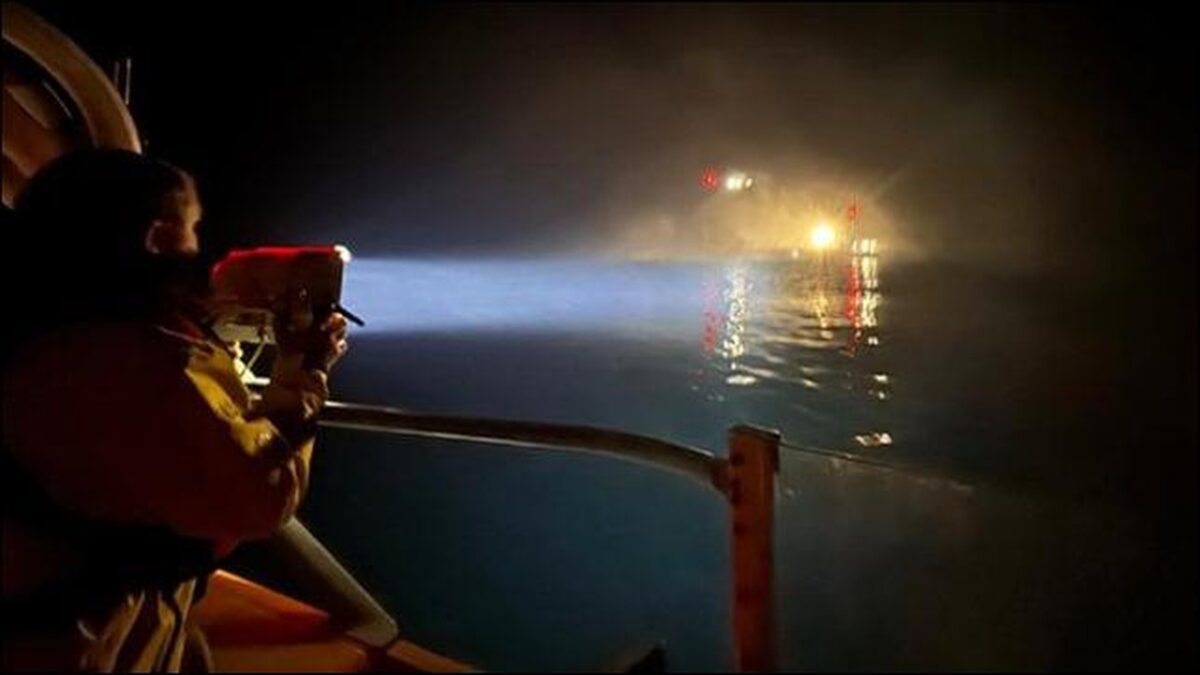
Leading the coordinated effort, `HM Coastguard` swiftly took charge of organizing the complex `medevac`. Their command center became the nerve center for orchestrating the multi-agency response, bringing together air and sea assets. The gravity of the injured `seafarer’s` condition meant a rapid `airlift` was the preferred method of evacuation. Concurrently, the `Salcombe RNLI` launched its `all-weather lifeboat` at 22:00, standing by to provide crucial assistance and support during the `rescue` and until a `rescue tug` could secure the `disabled vessel`. The presence of the `lifeboat crew` on scene offers reassurance and a vital secondary support system, demonstrating the robust layers of `maritime emergency services` available in UK waters. This critical coordination between `HM Coastguard` and `RNLI` exemplifies the gold standard in `maritime search and rescue`.
The `Coastguard rescue helicopter` played a pivotal role, lowering a highly trained `paramedic` onto the `cargo ship’s` deck. This daring maneuver, performed in the dark and over potentially turbulent waters, showcased the exceptional skills and bravery of the `rescue teams`. After assessing the injured `crewmember`, the decision was made for an immediate `airlift`, emphasizing the urgency of the medical situation. The `seafarer` was then safely hoisted aboard the helicopter and transported directly to a hospital in `Portsmouth`, where specialized medical care awaited. The efficiency of this `medevac operation`, from initial assessment to successful transfer, speaks volumes about the rigorous `training` and advanced capabilities of `HM Coastguard` `air crews` and `paramedics`. Such precision is paramount in `offshore rescue` situations, where every second counts for the patient’s prognosis. This incident highlighted the critical importance of `inter-agency communication` and `joint protocols` for successful `crisis management` at sea.
International Waters, International Response: A Collaborative Effort
The incident soon escalated beyond national boundaries, underscoring the complexities of `international maritime law` and `cooperation`. As the `cargo ship` drifted, it entered `French waters`, necessitating a seamless `transfer of coordination` to `French authorities` around 01:00. This transition, managed efficiently by `HM Coastguard`, demonstrates the well-established `international agreements` and `communication channels` that facilitate `cross-border maritime incidents`. Adding another layer of support, a `Dutch warship` also responded to the `mayday call` and stood by to offer assistance, showcasing the wider network of `naval support` available during `marine emergencies`. This multi-national response is a testament to the collaborative spirit embedded within the global `maritime community`, ensuring that `distressed vessels` and `seafarers` receive help regardless of their exact location in `international waters`.
Such `international cooperation` is not merely a courtesy but a fundamental pillar of `global maritime safety`. Protocols established under conventions like the `International Convention for the Safety of Life at Sea` (SOLAS) and the `International Convention on Maritime Search and Rescue` (SAR Convention) provide the framework for these coordinated efforts. The ability to swiftly and effectively transfer command and share critical information across national borders is essential for managing `complex marine incidents` that often transcend geographical limits. Ultimately, a `rescue tug` successfully reached the `vessel`, which still had five `crewmembers` aboard, and initiated plans to tow it to a safe `port`. This final phase of the operation, involving `vessel salvage` and `port operations`, is another critical component of `maritime incident management`, ensuring both `crew safety` and the integrity of the `marine environment`.
Prioritizing Seafarer Safety in Challenging Conditions
The `cargo ship fire` and subsequent `medevac` serves as a potent reminder of the paramount importance of `seafarer safety` in the challenging and often unforgiving `marine environment`. `Commercial shipping` inherently carries risks, from mechanical failures to severe weather, and robust `emergency preparedness` is the first line of defense. Regular `safety drills`, comprehensive `firefighting training`, and readily accessible `first aid facilities` are not merely regulatory requirements but vital components of a resilient `safety culture` aboard every `vessel`. This incident highlights how even well-equipped ships can face unforeseen dangers, making the human element of alertness and training indispensable. The rapid and effective response of the RDJ Waalstroom’s crew to the `engine room fire` likely prevented more extensive damage and further injuries, underscoring the value of continuous professional development for `maritime personnel`.
Beyond immediate response, `seafarer safety` encompasses a holistic approach including stringent `maintenance schedules` for `vessel systems`, advanced `navigation technologies`, and psychological support for `crew members` who endure long periods at sea and face traumatic events. Organizations like `HM Coastguard` and `RNLI` are not just responders but also advocates for higher `safety standards` across the `maritime industry`. Their work contributes significantly to reducing `maritime incidents` and ensuring that when emergencies do occur, the potential for harm is minimized. The focus on `crew protection` in every phase of `marine operations`—from vessel design to daily routines—is what ultimately keeps the global `shipping lanes` safe for both `seafarers` and the flow of `global trade`.
Advancements in Maritime Rescue and Emergency Protocols
Modern `maritime rescue` operations are increasingly leveraging technological advancements to enhance their effectiveness and speed. The deployment of `Coastguard rescue helicopters` equipped with advanced sensors, night vision capabilities, and precise hoisting mechanisms represents a significant leap from earlier `search and rescue` methods. These technologies allow `rescue teams` to operate effectively in challenging conditions, including darkness and adverse weather, which are common occurrences in areas like the `English Channel`. Furthermore, sophisticated `communication systems`, including satellite connectivity and digital incident management platforms, enable real-time information sharing between disparate agencies and national commands, as demonstrated during the `international handover` in this incident. Such `technological integration` is crucial for optimizing `resource deployment` and `situational awareness` during `complex marine emergencies`.
The evolution of `emergency protocols` is also a continuous process, with lessons learned from incidents like the `cargo ship fire` feeding back into training programs and operational guidelines. `Coastguard` and `lifeboat crews` undergo rigorous and specialized `training` that covers everything from `advanced medical care` at sea to `ship stability` and `firefighting tactics`. The ability to deploy a `paramedic` directly onto a moving `vessel` from a helicopter requires an extraordinary level of skill and coordination, refined through countless hours of simulation and real-world exercises. These ongoing enhancements in both technology and human expertise are pivotal in ensuring that `maritime rescue services` remain at the forefront of `life-saving capabilities`, ready to respond to any `marine incident` with maximum efficiency and safety.
The Broader Impact on Shipping and Marine Operations
While the immediate focus of a `marine emergency` like a `cargo ship fire` is on `crew safety` and `rescue`, such incidents also have broader implications for the `shipping industry` and `marine operations`. For `vessel owners` and `shipping companies`, a `fire` can lead to significant financial losses due to `vessel damage`, `cargo loss`, `salvage costs`, and `insurance claims`. Furthermore, investigations into the cause of the `fire` can result in regulatory changes, stricter `safety audits`, and potential penalties, emphasizing the commercial imperative of maintaining impeccable `safety standards`. The interruption to the `shipping schedule` also impacts `supply chains`, leading to delays and potential economic repercussions for goods in transit. This ripple effect underscores why `maritime safety` is not just a humanitarian concern but a critical factor in the global economy. Effective `crisis management` and `post-incident analysis` are vital for learning from these events and continually enhancing `operational resilience` across the entire `maritime sector`.
This incident involving the RDJ Waalstroom, the `cargo ship fire`, and the subsequent `medevac` in the English Channel, stands as a powerful testament to the unwavering dedication of `HM Coastguard` and the `RNLI`. Their `heroic efforts`, combined with effective `international cooperation`, ensured the safety of the `injured seafarer` and initiated the necessary steps to secure the `distressed vessel`. It serves as a stark reminder of the ever-present dangers in `maritime shipping` and the indispensable value of highly trained `rescue services` and robust `safety protocols`. As global trade continues to rely heavily on sea transport, the commitment to `seafarer safety` and `maritime emergency preparedness` remains a cornerstone of a secure and efficient `marine industry`.