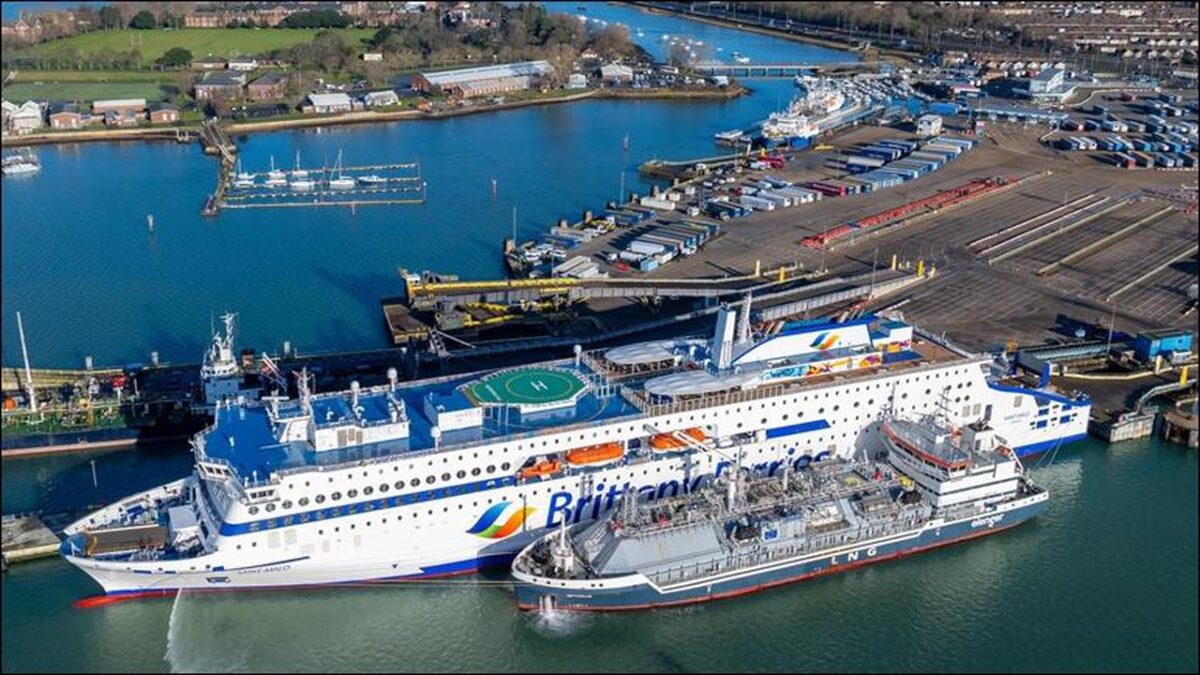
BV Verifies Methane Slip on Brittany Ferries LNG Ships | Mariner News
In a significant stride towards greater environmental transparency and accurate emissions reporting within the maritime sector, Bureau Veritas (BV) has successfully verified methane slip measurements on a quartet of liquefied natural gas (LNG)-fuelled vessels operated by the renowned ferry company, Brittany Ferries. This crucial development allows these ships to report actual methane slip values, moving beyond generic default factors under stringent regulations like EU MRV and FuelEU Maritime. The verification underscores a growing industry commitment to precise environmental accountability and sets a new benchmark for other operators employing LNG as a transitional marine fuel.
This verification effort, particularly notable for its meticulous approach, focused on four vessels: the Salamanca, Santona, Saint-Malo, and Guillaume de Normandie. For these modern vessels, Bureau Veritas’s thorough review means that their operators can now leverage precise, measured data for their environmental compliance obligations, a critical advancement as methane slip becomes an increasingly scrutinized element of marine emissions. This proactive step by Brittany Ferries, supported by BV’s expertise, highlights a dedicated push towards enhancing environmental performance and reporting accuracy in a rapidly evolving regulatory landscape, directly contributing to more sustainable shipping practices across the global fleet.
The Critical Role of Methane Slip in Maritime Emissions
Methane slip refers to the unburned methane gas that escapes into the atmosphere during the combustion process of LNG in marine engines. While LNG is widely recognized for its ability to significantly reduce carbon dioxide (CO2) emissions and virtually eliminate sulfur oxides (SOx) and particulate matter compared to traditional heavy fuel oil, its environmental benefits are partially offset by methane slip. Methane (CH4) is a potent greenhouse gas, with a global warming potential far greater than CO2 over a 20-year timescale, making its accurate measurement and reduction paramount for achieving genuine decarbonization in the shipping industry. The industry’s reliance on LNG as a cleaner transitional fuel necessitates a comprehensive understanding and precise management of methane emissions to truly gauge the environmental footprint of LNG-powered vessels.
Regulatory bodies worldwide, including the International Maritime Organization (IMO) and the European Union, are intensifying their focus on methane emissions from shipping. Programmes like FuelEU Maritime are pushing for greater transparency and mandating reporting based on actual, rather than default, emissions data. This shift reflects a broader recognition that simply reducing CO2 is not enough; the full spectrum of greenhouse gases must be addressed. Shipowners and operators are thus under increasing pressure to invest in technologies and methodologies that not only minimize methane slip but also provide robust, verifiable data to demonstrate their environmental stewardship. Understanding the nuances of methane’s atmospheric impact is key to developing truly green shipping strategies and ensuring that LNG’s role as a bridging fuel is optimized for maximum environmental benefit.
Bureau Veritas’ Rigorous Verification Methodology
Bureau Veritas Marine & Offshore, a world leader in testing, inspection, and certification services, conducted the rigorous verification process. Their methodology involved a comprehensive review of necessary documentation, including engine-specific methane files and meticulous onboard exhaust measurements. This process adheres strictly to the guidelines set forth by IMO Resolution MEPC.402(83), which provides a framework for measuring and reporting methane emissions. By following these international standards, BV ensures the integrity and reliability of the verified data, offering a robust foundation for environmental reporting. The move away from default factors, which often represent worst-case scenarios, to actual measured values provides a far more accurate representation of a vessel’s environmental performance.
For the vessel Salamanca, for instance, monitoring was diligently conducted over an extensive 12-month period across its operational routes between Rosslare-Bilbao and Rosslare-Cherbourg. The results were compelling, demonstrating that methane slip values were significantly below the default levels, which can be as high as 3.1% referenced in both regulations and IMO guidelines. This finding is a testament to Brittany Ferries’ operational practices and the efficiency of their LNG propulsion systems. The French flag administration’s subsequent approval of the data and its confirmation of the verified values further validate the accuracy and credibility of BV’s robust verification process, solidifying the data for regulatory compliance and public reporting. This level of detail in emissions monitoring is critical for navigating the complexities of modern maritime environmental regulations, providing operators with a clearer, more precise picture of their ecological footprint.
Brittany Ferries’ Proactive Stance on Environmental Transparency
Brittany Ferries’ decision to actively pursue this methane slip verification underscores its profound commitment to environmental transparency and sustainable operations. By opting for measured emissions data over default factors, the company demonstrates a proactive approach to environmental compliance and a genuine desire to accurately report its ecological impact. This strategic move not only enhances their credibility with regulators and customers but also provides a clearer understanding of the actual emissions profile of their advanced LNG-fuelled fleet. It positions Brittany Ferries as a frontrunner in adopting best practices for environmental stewardship within the ferry sector, showcasing leadership in marine sustainability.
This commitment extends beyond mere compliance; it’s about providing a more granular and truthful basis for evaluating their environmental performance. The positive results, showing methane slip significantly below default levels, validate Brittany Ferries’ investment in modern, efficient LNG technologies and their operational excellence. For customers and stakeholders increasingly concerned about climate change and the environmental footprint of transportation, such verifiable data offers reassurance and builds trust. The company’s actions contribute directly to the broader industry’s journey towards decarbonization, illustrating how robust measurement and verification can lead to tangible improvements in environmental reporting and operational efficiency.
Broader Industry Implications for Sustainable Shipping
The verification of methane slip data for Brittany Ferries’ LNG-fuelled ships carries significant implications for the wider maritime industry. As global regulations become increasingly stringent and the push for decarbonization accelerates, the ability to accurately measure and report greenhouse gas emissions, particularly potent gases like methane, will become indispensable. This case study demonstrates that moving beyond theoretical assumptions to actual, verified data is not only feasible but also highly beneficial for shipowners and operators. It provides a robust framework for environmental compliance, potentially leading to more favorable ratings and reduced penalties under future carbon pricing mechanisms.
Furthermore, this development encourages other shipping companies utilizing LNG or considering it as a fuel option to invest in similar verification processes. It highlights the importance of comprehensive emissions monitoring programmes that track the true environmental performance of alternative fuels. The lessons learned from Brittany Ferries’ experience can inform the development of industry best practices, driving a collective effort towards greener shipping. As technology advances, the precision in measuring and mitigating methane slip will undoubtedly improve, further solidifying LNG’s role as a transitional fuel while enabling continuous environmental enhancements across the maritime supply chain. The pursuit of sustainable shipping demands this level of scientific rigor and operational transparency from all stakeholders.
The Evolving Landscape of LNG and Emission Reduction
The future of LNG as a marine fuel is intrinsically linked to the industry’s ability to effectively manage and reduce methane slip. While LNG offers immediate benefits in terms of CO2 and pollutant reduction, ongoing research and development are crucial for addressing the methane challenge. This includes innovations in engine design, such as high-pressure injection systems, and the development of post-combustion capture technologies or oxidation catalysts to further minimize methane emissions. The verification efforts by Bureau Veritas provide valuable real-world data that can feed into these research initiatives, offering insights into the actual performance of current LNG technologies under operational conditions.
The maritime sector is at a pivotal juncture, navigating the complexities of decarbonization amidst growing environmental scrutiny. Initiatives like the one undertaken by Brittany Ferries and Bureau Veritas are vital steps in this journey, demonstrating a practical pathway towards verifiable environmental performance. They underscore that achieving a truly green shipping future requires not only cleaner fuels and advanced technologies but also rigorous, transparent, and internationally recognized verification processes. As the industry continues to innovate, the focus on accurate methane slip data will remain a critical component of achieving global climate goals and ensuring the long-term sustainability of marine transportation. This collaborative effort sets a compelling precedent for other operators to embrace enhanced environmental monitoring as an integral part of their commitment to ecological responsibility and operational excellence.