Are We Asking the Right Questions About Wind Assist
Wind assisted propulsion has moved out of the concept stage and into routine commercial and technical discussions across shipping.
In the last eighteen months, many owners have been approached through classification societies, charterers, and public decarbonisation programmes to take part in structured wind assist trials. This is happening against the backdrop of the IMO’s Carbon Intensity Indicator and the EU’s FuelEU Maritime and EU ETS regimes, all of which increasingly link operational efficiency to commercial and regulatory outcomes.
The pattern is usually similar. A system is installed on a selected vessel, several voyages are monitored, and fuel and performance data is collected to support investment decisions and regulatory planning.
For the technical teams involved, these trials are rarely treated lightly. Superintendents and fleet managers track daily performance, weather routing, power demand, and crew feedback. They are trying to understand not only whether a system works, but under what conditions it works, and how it affects the vessel’s compliance profile.
The difficulty they keep coming back to is variability.
Wind close to the sea surface is shaped by waves, temperature layers, vessel speed, and routing. A change in rpm, a weather deviation, or a different loading condition can alter the airflow around the ship. As a result, two vessels running the same equipment on similar routes can end up reporting very different outcomes.
This makes it difficult to draw firm conclusions from short trial periods, even when the data is carefully collected and aligned with CII or FuelEU reporting.
It was against this backdrop that we spoke with Aldo Cattano, founder of Windtracx.
Cattano’s background is in aerospace engineering, including aircraft certification and autonomous flight systems. When he began looking at maritime wind assisted propulsion, he focused less on sail area and more on how much control the system had over the air it was working in.
Many existing technologies operate at different heights, but they all remain embedded in atmospheric conditions that change minute by minute. They can only react to what the wind provides.
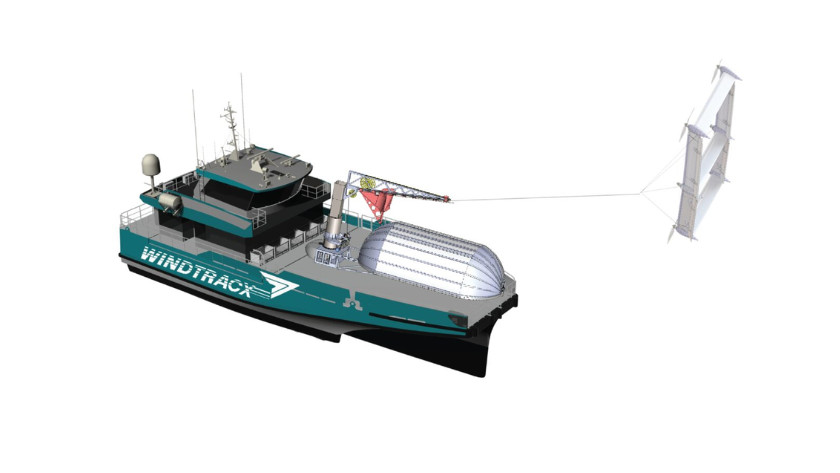
Windtracx takes a different approach. Its system launches a rigid wing aircraft from the ship and flies it at several hundred metres above the surface. At that altitude, the airflow is generally smoother and more stable. More importantly, the wing is actively flown.
By flying controlled patterns, the aircraft generates its own apparent wind. The faster it moves through the air, the more aerodynamic force it can create. From an engineering point of view, this shifts the system away from waiting for usable wind and towards producing lift through motion.
For technical managers evaluating wind assist in the context of CII scores, charter party clauses, and FuelEU compliance, this distinction matters. Passive systems respond to whatever wind they encounter. An actively flown wing introduces a degree of control that may allow performance to be adjusted and compared more consistently.
There is also a secondary effect once the wing is airborne. From a few hundred metres above the ship, the aircraft can observe a wide area around the vessel, including wind patterns, approaching weather, and nearby traffic. In that sense, it becomes both a propulsion device and an airborne sensor.
Whether this type of system can meet the reliability, safety, and class requirements of commercial shipping will only become clear through extended trials and operational experience. What is already clear is that wind assisted propulsion is evolving beyond sails and rotors into systems that draw heavily on aerospace technology.
For owners and technical teams building decarbonisation strategies under IMO and EU frameworks, this adds both opportunity and complexity. The systems being trialled today may not look like those that are widely deployed later in the decade.
At Mariner News, we continue to follow these developments through discussions with operators, classification societies, and technology developers as wind assisted propulsion moves from pilot projects to operational use.
WindTracX Sagl
6527 Lodrino, Switzerland
Phone: +41 76 208 2393
Email: info@windtracx.com
Web: windtracx.com